
FlyerAlarm began business in a garage in southern Germany in 2002 producing flyers. Today the business operates across several sites in Wurzburg and receives more than 15,000 orders a day with an average order value of €70-80 each.
There are 2,000 or so staff (with a company growing at these rates, precision is tricky) and operations across 30 countries. Another six sites are to be added soon.
The company keeps quiet about the equipment it uses, believing this to be a competitive advantage, but the line up includes KBA and Heidelberg sheetfed presses and one of just two Heidelberg Jetmaster Dimension 4D printers in operation. This prints personalised messaging on footballs, tying in no doubt with the company’s sponsorship deals with Bayern Munich and Borussia Dortmund.
As yet it does not sponsor English or Scottish football clubs, but this cannot be ruled out. UK country manager Alexandra Lange came to London five years ago from the company’s Spanish operation. “This company is growing very fast. Sometimes it’s scary how quickly it’s growing,” she says.
FlyerAlarm is unique among the online print businesses in having a physical location that customers can visit, namely a shop just of Tottenham Court Road in the centre of London, close to the heart of London’s traditional Adland. And ad agencies, marketing agencies and departments are the key customer base. There are also other printers acting as agents, but very few end consumers. “90% of customers are B2B,” says Lange.
What they buy is constantly changing. The company may have started with simple flyers and the like, quickly moving to folded and stitched products and more recently into textile printing, 3D printed figurines and footballs. The common thread is items needed by marketing departments for promotional purposes.
There is a team which works on printing on different materials and devising new products which are tested and if successful, added to the almost 3 million different combinations of material and product that can be bought through the websites. The 3D printing of figurines for example is restricted to Germany currently. “It’s something that we believe the London market will be keen to have,” she says. If so there will be samples in the London store.
This is a showcase for the types of product that the company can produce. “It’s like a marketing department where we can give advice to customers and provide ideas. It’s like a toy store for product managers and somewhere they can have a chat. It’s important for us to support customers with samples, and not to be just on line.”
There is a samples box too for printers that sign up as agents with FlyerAlarm. This can be branded to the printer she says. “We are developing a programme to support partners. We can offer a personalised delivery for these printers who can use us to provide the sorts of product that he doesn’t offer. The samples box can be branded or neutral as can delivery.
“We think it’s important because people want to work with their local printer with whom they already have a connection. We want to support the local printers.”
The technology to handle 15,000 orders daily was developed inhouse, sometimes making the best of third party applications where it can integrate them. But there is no outsourcing of coding to India or other off shore locations. “One of the reasons for our success is that we control every step, every process,” Lange says. There is a constant examination of what works and what almost works. If something can be improved, it is. “Because we are selling on our reputation. Customers return because of the resource. It is not only about price.” This is underlined by a complaints rate of just 1%.
The customer experience is also about transparency. The company prides itself on showing all-in prices, no hidden VAT or delivery charges, Lange explains.
The self examination means looking at ways to speed up delivery. An order before 9am can be back with the customer the next working day and FlyerAlarm is testing new products that Lange explains may be produced more quickly “provided there is no reduction in quality.
“It’s needed because customers always forget an order they needed to place for the event that kicks off tomorrow.”
It means that FlyerAlarm is considering a more local production site to overcome any delivery issues, and to manufacture locally items that are difficult or expensive to ship. “It would be about being more competitive with delivery times,” she explains.
There is also potential in more bespoke service. There are customers that like working with FlyerAlarm that want to go beyond the standard papers and product types that are displayed through the websites. In these instances a call to the company will return a quote.
The online print business starts to migrate into a more conventional way of doing business, but with the economies of scale permitted by the internet.
“The market is moving towards online printing,” says Lange. “We think that people want to see what a wide range we can offer. This is a company that is growing fast. And it’s a lot of fun.”
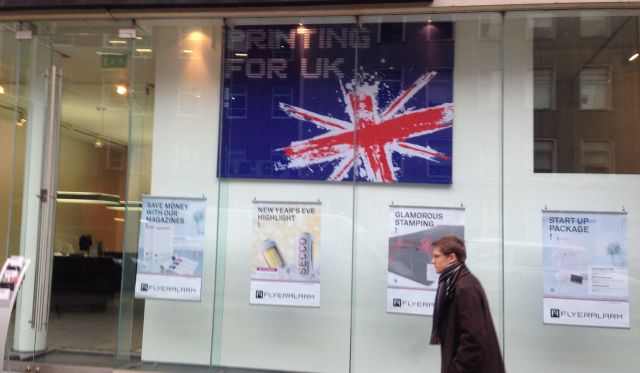
FlyerAlarm is unique among the online print businesses in having a physical location that customers can visit, namely a shop just of Tottenham Court Road in the centre of London, close to the heart of London’s traditional Adland. And ad agencies, marketing agencies and departments are the key customer base. There are also other printers acting as agents, but very few end consumers. “90% of customers are B2B,” says UK country manager Alexandra Lange.