
Waterless litho printing has been one of the best kept secrets of the industry, something imbued with mystery where few printers dare to tread.
Even in Japan, the home of waterless, there are only about 500 practising waterless litho printers. In Europe there are 50 members of the International Waterless Printing Association. It exists to promote the use of a technology which delivers very high quality and environmental performance and which, if predictions about how water is used in future, will be more interesting.
One of the biggest problems with waterless printing has been that printers have had to rely on one plate supplier. Despite the advantages in terms of quality of print, reduction in waste and cleanliness of the print factory, the risk of being in hock to Toray has been too great.
It has slowed adoption of KBA’s Cortina waterless newspaper press where these advantages are perhaps greater than in conventional litho, despite Toray building a plate factory in the Czech Republic to tackle these issues.
Now, however, Presstek is launching a plate specifically for this sector: Zahara, a waterless litho plate that Presstek reckons has significant benefits over the Toray plate which has a virtual monopoly in the market.
The Zahara is a drop-in replacement, using the same chemistry, platesetter and processor as the Toray, but which can also run without chemistry as users become more comfortable with it.
“In the UK waterless litho is a very small part of the market,” Presstek UK managing director Ian Pollock says, “But elsewhere it is growing. This is thanks to the Codimag label press and to new machines from KBA and Miyakoshi for label printing.
“We want to get sheetfed litho printers to consider waterless. There is a big impact on the environment, on waste and on delivering high quality.”
Legacy issues around running waterless have been tackled by the newer generation of presses and all manufacturers can offer waterless presses, if not actively promoting them. One of those issues has been around the dependence on Toray, now distributed in partnership with inks produced by Classic Colours to strengthen the channel.
This provides a challenge to Presstek’s ambitions, but it is confident it has a strong product with Zahara. “It has performed well during field testing,” says Pollock,“ and according to some rolls up faster than the Toray plate.”
Presstek’s challenge is that aside from its own presses and KBA’s Genius UV machine there are very few printers choosing to print waterless. One that has done so for many years is Oxford printer Seacourt, recently installing a Sakurai with LED UV to run waterless, and with the company creating the ‘Light Touch’ brand to market it under.
The company wanted to use LED UV for its quality and speed benefits and Sakurai was willing to build a waterless machine so that Seacourt did not have to compromise its environmental stance. “We are delighted with where we are,” says managing director Gareth Dineage. “This is taking printing to another level and we are helping to push the industry.”
The second UV printer committed to waterless is Park Lane Press, Corsham, where a spotless factory is testament to the lack of spray powder and equally clean presses show the benefit of running without powder infiltration nor water, both of which have a corrosive effect.
Others have looked or dabbled in waterless over the years, turning back because of the plate or press controls were not up to the task. Those issues have been tackled. All press manufacturers are able to build a waterless litho press even if promotion of the technology is below the radar.
Without water on press, there are no water balance issues to deal with, while the flow of ink is managed by temperature controlled rollers. This is a technology that is mainstream across all presses, not restricted to waterless machines.
The arrival of an alternative plate will be welcomed, especially by newspaper printers that are running the KBA Cortina waterless press. This includes the Le Figaro plant to the north of Paris and others where waterless allows the press to print newsprint and improved papers for commercial products with the same press set up.
However, Zahara is not available as a newspaper plate. But given the volumes used in newspapers, it is a gap that has to be filled.
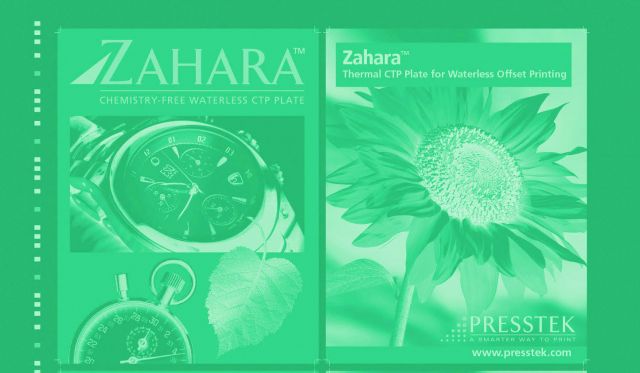
Zahara from Presstek is a waterless litho plate that the company reckons has significant benefits over the Toray plate which has a virtual monopoly in the market.