
Drupa Hall 7a B40
Massivit Technology is an Israeli start up with a 3D printer, which is not particularly unusual until you are the fact emerges that the printer can create a life sized printed man in around five hours.
As its name hints, Massivit is printing on a grand scale, 3D large format printing – and companies from the display graphics world are those that will be its first customer base.
And like many Israeli tech businesses in the graphic arts, the company’s leaders have a criss crossing connections. Founder Gershon Miller previously founded Objet, later sold to Stratasys and had started Idanit which was sold and became Scitex Vision.
Co-founder Moshe Uzan worked at Idanit, staying with the operation becoming R&D manager of HP Scitex.
CEO Avner Israeli spent 22 years at Scitex before joining Stratasys and then Massivit Technology. Others have a similar background in large format inkjet, have worked for Scitex in some guise or as with director Amos Michelson, with Orbotech and Creo. Even marketing director Lilach Sapir has worked for Scitex Vision, HP and more recently for Landa Digital Printing,
It amounts to an almost unmatched experience in inkjet and 3D printing, helping to build the large format digital print sector and likewise in 3D printing. The strategy is to do the same in an entirely new sector. In order to generate large 3D sculptural objects until now, it has been necessary to print in several pieces and assemble them like a piece of Ikea furniture.
“To do this we have had to develop a new technology, not just new machinery,” says Sapir. The Massivit uses the same plastics as a standard 3D printer, but instead of jetting these through an inkjet head, Massivit extrudes the melted paste through a small nozzle like some vast piping bag. The company calls this Gel Dispensed Printing. The XYZ gantry and rotating head moves the head as it builds up the object in a continuous movement. As soon as the paste is in place it is cured by UV LEDs
The result is a 3D piece that can be six feet tall in translucent plastic that has the same feel and finish as a conventional 3D printed item. It would need further work to be completely smooth, but just as poster printer does not need the finest of screens, so these types of model do not need the absolute smoothness of engineering prototypes. The object can then be wrapped or painted as part of the finishing cycle.
The company expects these objects to become promotional items in retailers or at marketing events, not far removed from the displays that many large format print businesses already design and create. Because the finished item is made of lightweight material and is hollow, a life sized man weighs only a few kilos and is comfortably portable. The print area is 1.2×1.6 metres across and 1.8 metre tall, enough she points out to print a standing person. And the process of curing means that there is no need to build in struts to support the object as it builds.
“We are adding another dimension to the services a display print company already produces,” she says. The marketing impact of retail theatre is already appreciated, calculated as having five times the impact as a flat display. The extra impact of a super large bottle of detergent, fizzy drink or a cup cake ramps this by several notches. “It means a bigger return on investment for the advertiser,” she adds. Outdoor events and exhibitions are other immediate applications as are theatrical props. “And it will open up a range of new applications,” Sapir continues.
Retail is the initial target. Digital display printing has already helped revolutionse the way that many stores work. They have broken out of the conventional three month seasonal cycles to run campaigns that may last only two weeks. “That alone has increased marketing expenditure. And it affects other areas as well. A theme park would be able to add to or change the characters according to the time of year removing sculptures that have become irrelevant for that season. The characters will also be more animated than is possible when making them from a mould.”
The file to drive the printer can be created from a standard Cadcam application, from an animation software or from scanning a prototype. Lilith predicts that agencies will hold approved 3D files for a range of celebrities so that a child might have David Beckham at a birthday party or James Bond might be invited to a corporate event.
To date this is speculation. Massivit has shipped systems to a customer in Israel, one in North America and has installed one in France. The market needs to be nurtured and developed to create the demand. It will not be as difficult as 20 years ago when superwide format inkjet printing was new. Today’s marketing led culture demands novelty and innovation.
The machines are not an everyday purchase, but equally not beyond the scope of the leading display print companies “more than £$100,000 but less than $1 million” she says. “We are taking it slowly. We want to be alongside customers to provide support and nurture them. It’s the same way that Scitex Vision was built up.”
There are other super-sized 3D printing machines in the market. German company Voxeljet has machines that can print to 4 metres high, but its output is geared towards moulds for engineering purposes, though products are used to make props for films. In the US giant printers are used in the car industry and elsewhere in construction. Massivit is, however, the first with the point of sale sector in mind where its technology literally adds another dimension to large format inkjet.
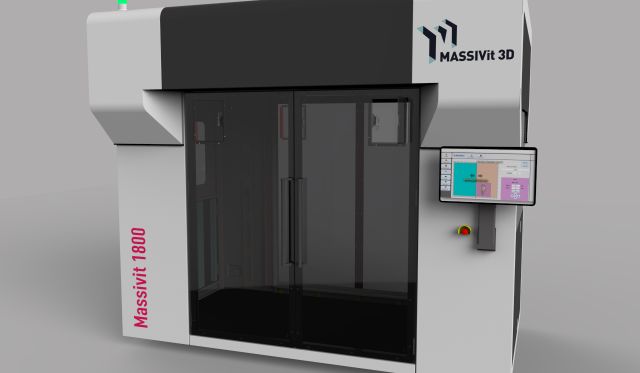
“To do this we have had to develop a new technology, not just new machinery,” says marketing director Lilach Sapir. The Massivit uses the same plastics as a standard 3D printer, but instead of jetting these through an inkjet head, Massivit extrudes the melted paste through a small nozzle like some vast piping bag. The company calls this Gel Dispensed Printing. The XYZ gantry and rotating head moves the head as it builds up the object in a continuous movement. As soon as the paste is in place it is cured by UV LEDs
The Massive 1800 is unlike other 3D printers. It uses a new Gel Dispensing Print technology to build 3D objects at unprecedented speeds, more than 300mm an hour vertically. The target users are from large format printing looking to add an extra dimension to the banners, posters and displays they create.