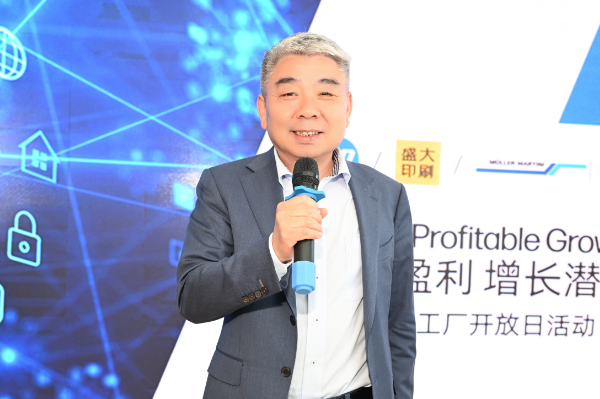
Heidelberg has received an order for ten Jetfire 50 inkjet presses from Shengda Printing Technology in China just a few months after selling the online print company its first inkjet press.
That machine was installed in June and joined a line up that includes around 200 Heidelberg litho press units, five HP Indigo 100K, Landa Digital Printing S11P, five Durst Tau label printers and Komori Lithrone GX40 RP, Lithrone 37s and Lithrone 46 on the litho side. This is a format that equates to 16A4 pp to view and is double the format of the SRA1 format.
The company also runs HP Advantage 2200 inkjet presses into Hunkeler and Muller Martini finishing lines for perfect bound books and stitched products. In all the company operates 100 production lines across its sites. This is funded through sales that reached $400 million in 2023.
Heidelberg will begin delivering its ten-press order before Christmas with two to be installed. The complete set will be placed across several of Shengda’s sites.
The investment will enable the company to reduce labour costs and increase automation, reducing each shift’s crewing by two or three operators thanks to automation from digital production files in a JDF format.
Shengda founder Cui Wen Feng says: “The Jetfire systems’ level of automation and performance is impressive and perfectly matches our vision of a digital future. In the medium term, we are planning to install between 20 and 30 digital production lines. Investing in the Jetfire systems marks a key step toward this goal.”
One product type is a brochure where the inner pages are identical but the covers are customised or personalised.
The company currently produces 6 million A4 pages a month digitally and has enough capacity for 8 million printed in this way.
Heidelberg’s reading of market developments is that digital printing, including service and consumables, will grow by 50% over the next five years, an increase from its current level of €5 billion to €7.5 billion by 2029.