When Kodak added an obligatory codicil to its Q2 results nobody in the business could have expected the explosion that followed. Instead of discussion of the company’s results, a slight decline in revenue, a big switch in operating profits and a significant cash burn, the reports stuck to the codicil and decided that this was a sign that was in financial trouble.
Kodak had warned that it currently had nothing in place to repay $500 million of debt falling due in May next year. There are advanced plans to sell off its pension plan to a third-party insurance business which after calculating its obligations to beneficiaries of the plan would return the excess to Kodak. Because the exact amount could not be calculated and the deal has not yet gone through, US financial law dictates that a warning needs to be attached to the results.
This was enough to provoke the financially illiterate to pronounce the imminent demise of the business: it would have to file for bankruptcy for the second time; it would need to embark on a series of sell offs; or it would simply close its doors.
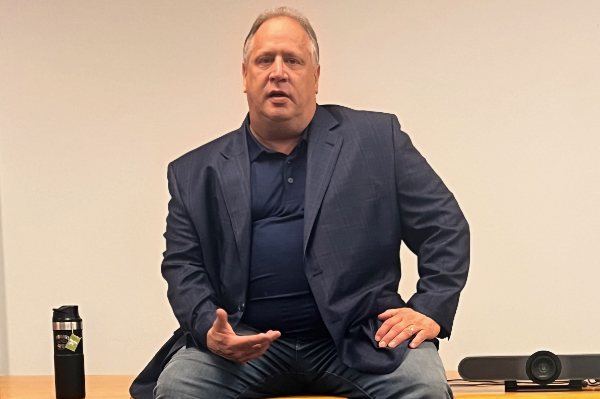
As chairman and CEO, Jim Continenza has long steered the company towards the sell-off of the pension plan in order to eradicate a debt mountain, to leave the company largely debt-free and to continue the development of its expanding Advanced Materials and Chemicals division and particularly its fledgling pharmaceutical business. These would balance the continuing decline in plate volumes and help diversify the business. “De-levering the business and strengthening our balance sheet has been a key initiative since day one,” he says.
Now with the finishing line in sight, Kodak has been forced to issue statements refuting reports that it is about to go out of business. To clarify the issues, the company had to make clear that “Kodak is confident that it will repay, extend or refinance its debt and preferred stock on or before its due date. When the transactions we have planned are completed, which is expected to be early next year, Kodak will have a stronger balance sheet than we have had in years and will be virtually net debt-free”.
The response was unexpectedly fierce because the interim figures show a slight drop in revenues at $510 million ($516 million). This fed through to a net loss of $33 million compared to a $58 million net profit in the first six months of 2024.
Sales of plates and inks dropped as a result of economic uncertainty, from $262 million to $243 million with equipment sales stable. Kodak hopes to gain as the only plate company able to manufacture in the US, albeit with imported aluminium. It is laying the ground to increase ink sales as Continenza says that a number of Prosper Ultrastream 520s are in the course of installation and once operational will consume a lot of ink.
In all revenue from the print sector dropped to $343 million ($368 million), while the Advanced Materials and Chemicals division increased sales to $149 million ($132 million).
While in the first half, the company’s cash reserves fell by £46 million as a result of investments in the new pharmaceutical division, an impairment charge and decline in pension income. Most of this fell in the first quarter. In the second quarter the cash reserve fell just $3 million.
The company has so far not suffered any adverse impact from the imposition of US tariffs it says though does point to increasing prices of aluminium and manufacturing costs as factors in squeezing margins and reducing operational Ebitda, mitigated by a lower spend on IT and the absence of spending on a Drupa style exhibition this year.