The transformation of printing from analogue means of production – litho, flexo et al – to digital means of production has been underway for many years. The process has already converted display graphics printers who no longer use screen presses or very large format (and often very old) litho presses to produce posters but instead have adopted large format inkjet and expanded what they can print into textile materials and solid substrates as well papers.
Inkjet is rapidly swallowing up book printers where continuous feed inkjet suits shorter runs, flexible production better than using older Timsons or newer Manroland Goss or Indian litho presses.
Some reckon that label printing will be the next sector to become dominated by digital printing while direct mail is rapidly succumbing to the appeal of inkjet.
The big prize though is commercial print for despite reducing demand across the world creating something of a commercial print crisis, there are trillions of pages printed each year on litho presses. The transition has begun: it is almost impossible to buy a small format litho press such is the dominance of toner machines in the two page sector. But toner has problems in printing at higher speeds of on larger sheets, which has been a barrier protecting the litho world. This barrier is now being chipped away: HP Indigo probably sells more B2 presses than SRA3 formats, Fujifilm has plans for a B2+ toner press and there are multiple sheetfed inkjet machines on the stage or are waiting in the wings for their great entrance,
All this was evident at the 2025 Hunkeler Innovation Days. Many of the live projects may have been about optimising book production, but many of the developments were about addressing the issues that commercial printers face.
This is a long way from the early days of Hunkeler Innovation Days 20 and 30 years ago. It began as an open house to show off Hunkeler’s prowess at manipulating reels of paper almost exclusively for the transactional market. The papers used were all uncoated and within a limited range, as what was produced ended up going in the post and needed to be as lightweight as practical. There could be one piece mailers, letters with variable perforations, small booklets for inclusion in the mailed piece, barcode matching. And printed with a variety of technologies.
Transactional work now accounts for 24% of Hunkeler’s revenue. It is a shrinking market as invoices and statements become digital, but will not disappear completely. Today the biggest market for Hunkeler is publishing, accounting for 46% of revenue followed by direct mail at 16% and commercial print at 14%. “Publishing will remain the dominant sector for quite a number of years, requiring the most complex systems,” says Hunkeler chief executive Daniel Erni. “We are convinced that transactional will remain relevant for years to come, with strong development in direct mail and commercial printing. This is what we have been working on and hoping for; and where we are expecting positive developments in future.”
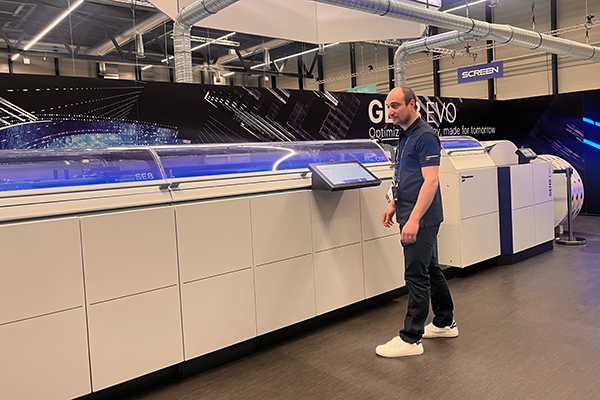
It is also where new owner Muller Martini can add tremendous value. Its saddle stitching and perfect binding lines have had to cope with the different weights and styles of paper that commercial printers use without dropping a beat. There were a number of Vareo binders in operation during the show as well as digitally fed saddle stitching, which existed pre acquisition. Now Muller Martini’s experience has been brought to bear in the Gen 8 line of products, including the Gen 8 Evo which received its public launch in Lucerne.
This starts with a new unwind unit, controlled through a simplified touch screen, into a cutting, slitting and delivering stacks of finished products. Hunkeler has been able to do this for many years, but not before at 180 metres a minute on paper to 250gsm, which is coated and which will have heavier ink coverage than expected from transactional or book printing. Muller Martini’s input has included optimisation of the paper path to ensure it is more effective and reliable. This is a machine designed for commercial print applications.
Control is via a touch pad which slides along the machine with the operator who interacts with a simple to follow interface. This is a clear response to the challenge of attracting people to print with little background experience of the industry.
Lights are used to indicate status: green for all is running well, blue is ready to go, yellow is an alert that a reel will shortly need changing and red when the machine has stopped. A deeper red indicates where on the machine the problem lurks, something adopted from Muller Martini’s saddle stitchers and perfect binders.
It joins the Docutrim, Hunkeler’s finishing unit for cut sheet printing and often paired with Canon’s iX3200. A new version of the Docutrim will work with the emerging generation of B2 inkjet presses. The Starbook, which two years ago was the focus of the Hunkeler line up, gains a sheetfed version. Again this has an eye on the sorts of applications that a commercial printer would need to cope with.
Despite the interest in sheetfed inkjet, the only machines to fulfil this description on show at Innovation Days were the Canon iX3200, its Heidelberg liveried version the Jetfire 50 and Vazelus machines from Riso which are not suited to commercial printing. Out of sight but not out of mind were the Ricoh Z75 and two new machines from Canon, the iX1700 due this year and the iV7, due next year.
It is a decade since Venlo’s Project Niagara became the i300, the i320 and now the iX3200. There are 700 of Canon’s SRA3 inkjet presses installed worldwide, many alongside continuous feed inkjet presses and many displacing other digital presses to enable faster turnaround and longer production runs, inevitably taking some work that would otherwise have been printed on a litho press. Data is anecdotal rather than scientific at this point.
The two new machines will continue these processes. The entry level iX1700 will print on material to 450gsm and 660mm long and will compete with existing digital presses. It will have a two step drying system, 2400dpi imaging quality and new polymer inks. First customer installations will take place before the end of the year. “Customer engagements are ongoing,” says Canon Emea marketing director Hans Schmidbauer.
The iV7 follows a few months later. “It achieves a new level of productivity,” he says. This equates to 8,700sph and 4-5 million A4 pages per month in a 24/6 operation. It prints on a 750x614mm sheet.
“We have very good engagements with customers that see the potential to cut their costs and increase their productivity. There have been a lot of NDAs signed and visits to see it at the Venlo site. The first installation will take place before the end of 2025.”
Hunkeler though is traditionally about continuous feed inkjet, where Canon claims a leadership position in Europe at least. It brought the ProStream 2133 to the show, which is a more practical machine than the ProStream 3000 for space constrained printers. It still requires a lot of room to accommodate the lengthy drying sections which are a feature of the Canon machines. This has not prevented a strong up take, initially with book printers and more recently into direct mail and commercial print, albeit the iX3200 is leading the way for this sector.
The breadth of products and the length of time the company has been supplying the industry gives Canon perspective over what kinds of approach work best. “We are not just providing a product, but are also providing expert resources that are tailored to the needs of customers,” says Schmidbauer. This is through what Canon calls its professional services team. They can provide the data, the analysis and recommendations to drive a successful implementation. This includes relevant finishing and workflow as well as the print technology. “Professional services is able to break down walls,” he says. Examples of where Canon had delivered were displayed during the event with happy customers on hand to back up the claims.
It is not just about a selection of the right Canon products ring fenced from a wider workflow “but identifying the pieces we can best supply to improve the ecosystem, where workflow is really crucial”. Canon’s mature Prisma workflow, developed in the days of IPDS and transactional print, has the variable data capability and 30 years after its introduction has kept pace with wider developments and remains effective with a huge number of features and apps, to tap into. “Prisma has undergone continual development over the years, though no one printer will want to use all those features,” Schmidbauer says. “Saxoprint for example uses a Prinect workflow that then drives the inkjet machine.”
Others have teams to carry out similar customer implementation tasks, or at least those that have been active for a while. Ricoh classes this as part of its Henkaku approach of co innovation with customers.
“We consider that Drupa was the turning point for high speed inkjet and the transition from offset to digital says Ricoh Europe’s VP graphic communications group Eef de Ridder. “Inkjet is now mature and is taking over. We have seen the limits of toner technology in terms of speed quality and costs: we can’t reduce the costs and it can’t go faster.”
Fujifilm might argue with that as it has been pushing new technology in the toner sphere, but the scope for innovation is limited
While Ricoh remains very much attached to toner, its long term lies with droplets of water based ink. “We will put the mainstream of our R&D in higher speed inkjet and the software around it that is needed to maximise productivity,” he says.
It was a disappointment therefore that the four-day duration of the Hunkeler event prevented Ricoh from being able to run the flagship VC80000 or the cut sheet Z75, the presses that will have most appeal to the commercial printer. They had both been at Drupa and attracted crowds like a jam pot attracts wasps. “Drupa exceeded all our expectations,” de Ridder continues.
The first named customer for the VC80000 is Sattler in Germany, and he hints that others have the machine and are preferring to keep that fact to themselves. Cimpress for example has a number in operation. He says: “All the discussions we are having are about the transition and jump from offset to digital. It is really happening at the moment.”
“We look at the market as three distinct sectors,” says director of commercial print sales Sander Sondaal. “There is the commercial print market where they are producing flyers, brochures etc; the books market covering educational books, trade books and then the data driven market. And there is always an overlap between them. Workflows are distinct: in data driven markets, everything is focused on the page level, in commercial it is generally about the product level.”
There were samples from the absent machines on hand (along with the point of sale produced on its inkjet machines to hold the gift cards printed on the toner C9500 with its expanded ability to print on heavyweight stock). There have been improvements since Drupa. A sample is retrieved from below the counter. This shows the effect of a new waveform algorithm for the printheads on quality from the VC80000. It is noticeably less grainy in solid areas and was developed it seems on the insistence of a Japanese printer who demanded higher quality on the ephemeral flyers that are the mainstay of his output.
That is an example of the Henkaku approach, working with the customer to achieve a little more, which may then benefit the wider customer universe (depending on who is paying for the development time).
“Customers do not want just the standard business solutions,” de Ridder continues, “because there is just so much more to develop. To succeed we all have to look outside the box, hence we innovate with our customers, though we have to be selective about this and take on those projects which we can replicate elsewhere.”
Its other revelation for the event, and one very much in line with Hunkeler’s Connect theme, was a protocol to link the press to inline finishing, so that data can flow in both directions and so provide a clearer view of what is happening down stream of the press. If there is an issue with a paper jam for example, the message from the inline finishing unit might be to slow the press down until the jam is cleared.
The Ricoh press in operation as opposed to static display was the VC40000, both its oldest and newest machine. Its heritage is in the IBM IP5000, now upgraded to be capable of printing books as well as the data led documents that a number of those Infoprints or now outdated Xerox Trivors are producing. That heritage is also evident in Process Director, the advanced automated workflow that is part of the Ricoh portfolio. It is aimed at the complex installations where a Ricoh’s professional services team can integrate the press and peripherals into an automated ecosystem.
The commercial printer instead will work with Batch Builder. This can preflight a new job, produce an imposition or else implement something like Impostrip, identify the substrate to be used and use this information to group similar jobs. Thus the the flow of work that a commercial printer might execute according to delivery date, becomes one where efficiency takes centre stage. It makes sense to minimise changes to the paper roll used, or to group by imposition for efficiency in finishing.
Both workflows and presses are incorporating elements of AI and have been for some years says Sondaal. “There are scanners to identify colour and registration and software to make adjustments on the fly and to communicate this an MIS. It will also predict from the data gathered when a printhead is likely to fail so it can be changed in a way that minimises disruption.”
The new player in the market, filling the gap left by Xerox perhaps, is Fujifilm. It had been at Hunkeler previously with a small information stand to talk about its Samba and other printheads or to discuss the potential uses of its printbar. It had never before brought a continuous feed press.
This changed with the introduction of the 1160CFG, a 56cm wide continuous feed inkjet press running at 160m/min and capable of graphic arts quality, hence the G in the product name. Compared to some presses, this machine is remarkably compact with two identical print towers following a tower housing a series of rollers for stabilising the paper. This means removing moisture from the paper ahead of printing with water based inks to achieve a consistent surface – in effect drying before printing. Some post print drying is still needed, but far less than on other machines.
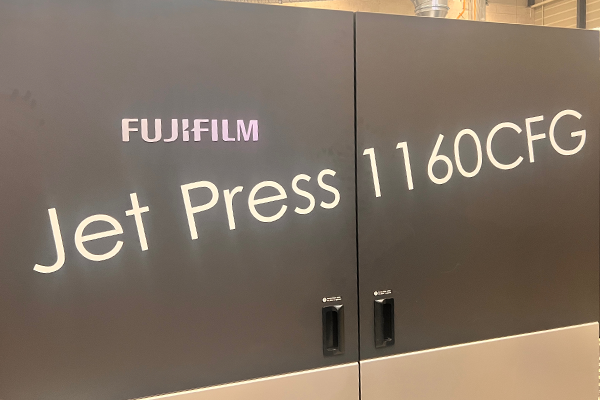
The claims for the approach are almost startling. Apart from reduced energy consumption, Fujifilm says the stabilised surface allows droplets to hold their shape on the surface of a coated paper; there is less penetration into paper fibres – both effects contributing to a sharper print with less graininess; the press can achieve faster speeds on less promising paper, up to the 160m/min for the 1200x600dpi mode.
While Fujifilm says it needs to be different to make an impact in the commercial print market, in the Asian Pacific market is class to be the leading supplier, thanks in the main to transactional style print. “Now it’s about bringing that technology over here,” says Fujifilm Europe business development manager Mark Stephenson. “While ink levels in transactional print are lower, there has never been a press of this quality for uncoated papers.”
The stabiliser winds the web through a series of heated rollers then cooling rollers to remove excess moisture from the paper. “There are no consumables, no priming fluid,” he says. “Because moisture content is reduced to 30%, the difference between image areas and non image areas is constant which means the paper stays flat without wrinkles. It’s all about reducing stress on the paper.”
Each print unit has its own drying system combining a heated drum and hot air, but this does not need to be as harsh as on a paper without the preparation. If it sounds too good to be true there are experts that proclaim that it is. Who is right will be decided on the streets or at least in the press halls across Europe.
The samples at Innovation Days showed caution, and running in line to a finishing system with a roll to stack finishing unit and to a rewind unit, ran through demonstrations. Discussions about the first UK installation are well advanced with delivery anticipated before the end of the year. Others can get to test their own papers and jobs at Fujifilm’s Advanced Press Centre in Brussels where an 1160CF will be installed shortly.
There is a single screen for a DFE and to control the press. The workflow too is distinct, though sharing the same UX as RevoriaFlow used on the toner digital presses. However, it is the novel approach to paper that grabs the attention.
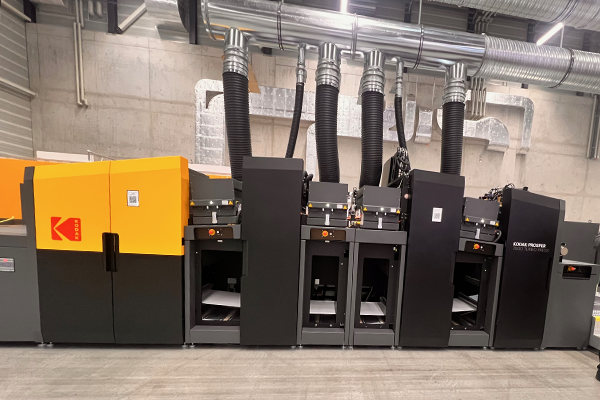
Kodak grabbed the attention with the Prosper 7000 Turbo, the fastest inkjet press currently on the market at 410 m/minute. It was put through its paces with short extracts from movies that had been made on Kodak film printed frame by frame on the press and viewed under a stroboscopic light to run like a film. The press became giant flick book.
This was something that literally no other company can do. Unlike other companies present in Lucerne Kodak balances its commitment to inkjet with an equal commitment to litho plates. While Fujifilm also produces printing plates, it has been reducing exposure in that direction to concentrate on digital printing. “This is the ‘and’ era of print,” says Kodak executive chairman and CEO Jim Continenza. “We have invested heavily in plates and plates are not going away. this will be a long transition.”
The speed marks this as a machine for high volumes of work. In the US, it is being used for educational books where production runs into thousands of copies. The size of different markets will limit the opportunities for a machine of this power. Samples from the Prosper Ultra 520, which had been launched at Innovation Days in 2023, showed that higher litho-like quality is within Kodak’s range, even if its machines are going to be out of the price range of the average commercial printer finding their way in inkjet printing. These are machines to replace litho book printing, or at least sit alongside litho book printing, and to perhaps replace web offset presses used for direct mail applications.
This is also the target market for two HP presses that were spoken about but which did not make an appearance in Lucerne. The PageWide T4250 is a 42in wide press described in detail elsewhere that can take on long run direct mail and commercial print applications and the PageWide T500M is a wider still inkjet book press targeted at litho book printing where existing presses are generally a little long in the tooth.
Back in Lucerne, HP had brought the PageWide Advantage 2200, which had made its European debut at Innovation Days two years ago, and coupled it to a combined Hunkeler and Muller Martini finishing line to produce books at a rate of 750 an hour. An Indigo 120K was used to produce covers. It was the most sophisticated demonstration of integrating technology for the exhibition and made full use of the show’s changed lay out. Harris & Bruno provided a Digicoater with a reel splicer from Contiweb to complete the line up.
HP has tweaked the technology over the last couple of years to be able to offer its top quality setting at 152m/min and to use the Smart Work Cell software to batch jobs using the same paper for example. It is also possible to interrupt a job to produce a machine proof. The paper limit has been raised to 320gsm, opening more graphic arts applications. It is equally at home with uncoated or coated papers, making it possible for a business to mix and match production. Paper handling logistics have been extended to the sheetfed press with an automated pallet change in place, AI based auto recovery functions to reset the press after a small misfire.
The combined effect says HP is a 30% increase in productivity and the potential to have one operator across two presses. Choice of print mode, whether four colour or EPM can now be delegated to an automated system based on overall ink coverage and customer preferences.
The sale of 40 of these B2 presses since Drupa and more than 40 of the more versatile 18k, is indicative of the offset to digital transformation according to VP and general manager of HP Indigo Noam Zilberstein. “And 30% of those customers are new to us,” he says. “With 50% of their output being new volume for Indigo.” Pricing, longer lasting inks and consumables are playing a part in increasing the footprint that this technology can address with a reduction in the total cost of ownership.
There is a move too from offset to digital for HP’s PageWide inkjet division. Current growth rates are 11% for publishing applications, 17% for direct mail and 25% for commercial printing. Again more than 40 of the Advantage presses have been shipped since launch but there has also been a change in job mix for existing T260 presses. These are averaging 1.5x the ink coverage per page of the T250 models according to Barbara McManus, suggesting that HP inkjet is producing more commercial print style pages.
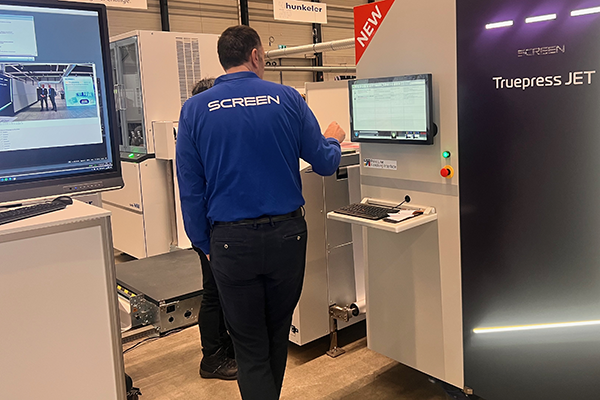
This is likewise the target for Screen. It had two presses running on the show floor, one the flagship TruepressJet 560HD. This is the press that is suited to the variety of papers and range of applications that will take on more litho print. The other press, the TPJ520N is the latest version of the long standing inkjet technology developed by Screen. The throughput has been upped to 225m/min, it suits mono or applications where colour is not absolutely critical – academic and educational books for example – and the show machine is off to long term customer Leaderform in Verona.
This machine is already printing litho work and was shown doing so, printing pharmaceutical leaflets which became booklets on an Ibis SmartLabel.
The 520N includes dynamic quality control scanners and the camera systems needed to monitor the integrity of print on the pharmaceutical application where litho has been the only to have the integrity to tackle this.
The application is for drugs trials where each label needs to be individual and to be traceable to link back to a database to monitor patient responses to the trial according to whether they are receiving the real drug or a placebo and whether this is administered with a doctor’s knowledge or completely blind. The Ibis SmartLabel collates the booklet with the labels in place and identified, index tabs are cut by laser, and the labels ready to use within hours rather than weeks needed previously. Three of the major pharmaceutical packaging suppliers worldwide have installed this system says Screen Europe senior VP sales Bui Burke.
“They are running with 45gsm paper but while happy with the quality from the 520N, have chosen instead to buy the 560HD because they felt they would need its higher resolution to print the 2D matrix code used.”
The 560HD remains a work in progress. Screen had initially earmarked HID in 2023 to launch the press, but was not happy and held the reveal until Drupa last year. The engineers and product managers in Japan are still not 100% confident so have again delayed the full commercial introduction for a few months. Nevertheless, one is in operation in the US and there is a machine for demonstration and application testing at the showroom near Amsterdam. “We hope to be in position to ship to customers by the end of the summer,” says Burke.
The last minute tweaks will result in what Burke believes to be a compelling package. Screen’s robust engineering is well known from its platesetters, cameras before that and from the longevity of the inkjet presses it has in the field.
The company has changed printhead supplies from Epson on the 520 models to Kyocera, a near neighbour in Kyoto, which supplies the flow through version of the KJ4 piezo printhead. The design is proving highly reliable.
Even so as part of strategy to reduce pressure on Screen and to help keep customers running as much as possible, access to the printheads is via a simple lever and heads can be replaced equally easily. As Burke says self maintenance like this is the only approach for a company gearing up for multiple installations in commercial print applications across Europe. It makes no sense to run a team of engineers and to charge printers large sums monthly for first line support that can be a combination of software, remote diagnostics and routine maintenance.
The dryer is a digital system, rapidly responding to the amount of ink and paper profile and differing on either side of the web. The press has a creep speed activated when a paper jam with an inline finishing unit needs attention. This prevents the press being put in sleep mode with the warming up and test printing that follows. With the 560 HD, print picks up precisely where it left off. “It’s not about running faster that increases productivity, it’s about making the machine more robust,” he says.
There is a significant productivity gain even without this. On the previous model many would run 1200×600 dpi flyers at 100m/min. As this resolution is there at 150m/min, there is an immediate 50% productivity increase.
Riso also had inkjet presses on show, these though target transactional rather than commercial print applications. Kyocera was not on the show floor and nor for the first time were Nipson or Xeikon with their toner technologies.
Finishing came from specialist book binding companies, Meccanotecnica with thread sewing for example, and for commercial print. Horizon had its own stand as well as StitchLiner MkV to transform printed reels into brochures and magazines. It also had the latest BQ300 single-clamp perfect binder and BQ500 four clamp and HT300 trimmer. Loose leaf book blocks were loaded by robot into the binder and on to the trimmer without the fascination that a few years would have greeted any robot arm or autonomous robot to move work in progress from point to point.