
It may not quite have been a return to the ‘good old days’, but there was a strong turn out for Heidelberg’s Simply Smart open house in Brentford last week.
Visitors across the two days could watch demonstrations on two Speedmaster XL75 presses, follow the job through high speed folding and on to a Muller Martini Primera MC stitching line. Linking it all was a Prinect system to deliver job files and production information and receive data back from the machines.
One press was set up in the latest press to stop mode for hands off printing. Sheetfed press sales specialist Matt Rockley explained that the average makeready time across the industry is eight minutes, proceeding to demonstrate that the press could have three jobs on the floor in that time. All the operator needed to do was load plates to the press.
During the plate loading time, blankets and cylinders are washed and the ink profile for the next job loaded. As it runs through a start up sequence, Inpress Control measures the sheet for colour and Quality Assist for fit. When both are achieved, the stack is tabbed and the counter started. As the run nears completion the ink profile is stripped from the rollers ready for the next job.
While operating in this way is unlikely to be replicated too frequently, Rockley made the point that there is increasing pressure on printers. “Ten years ago the average count on a B2 press was 15-20 million impressions a year; today customers are running 30-40 million impressions and with this technology they can move to 60 million impressions comfortably. This is what is happening in the industry.
“But you need the workflows and printers have to be organised so that processes can take place without manual intervention. Printers have been really interested in Quality Assist because it is this that allows them to raise productivity to new levels.”
Achieving this needs the sort of process management to batch paper type and preparedness to run with suitable consumables. For Heidelberg this means its higher pigment Saphira inks running with lower ink films and so drying faster, and with matched founts and washes.
Sappi was on hand to stress the importance of running with paper of consistent quality, in this case its Magno brand. Less expensive papers may be made at different mills causing consistency problems for printers in this high pressure environment where all variables need to be under control.
Where paper can change frequently, and especially where uncoated papers are required, Heidelberg is now promoting UV curing, either LE-UV (its option with a tuned mercury vapour lamp) or preferably its LED UV options where power consumption is even lower. Rockley describes one printer “producing 24 runs of 150 sheets in one hour: this machine is more productive and more cost effective than a B2 digital press”.
Heidelberg had created a composite uncoated sheet with the same image reproduced using conventional inks and with UV inks, in both standard and FM screening. The difference did not need explaining.
After adopting a cautious approach to new generation UV technologies only a couple of years ago, Heidelberg’s enthusiasm for UV is something of a change, though the company continues to point out that where UV printers find themselves competing like for like with companies running conventional presses, they will be losing margin because of the additional cost of the ink involved.
Muller Martini sales manager David McGinlay points out that the speed of the presses demands the use of equally productive finishing lines. This includes the Primera MC on show last week. It has servo motors throughout enabling automated simultaneous makeready across all settings and a turnaround time faster than the hoppers for a job can be loaded.
The machine is fitted with a vertical pile feeder that has been taken from the Heidelberg stitching lines that Muller Martini acquired 18 months ago. “We are finding that people are taking two existing lines out and putting one of these in and are producing more work,” he says.
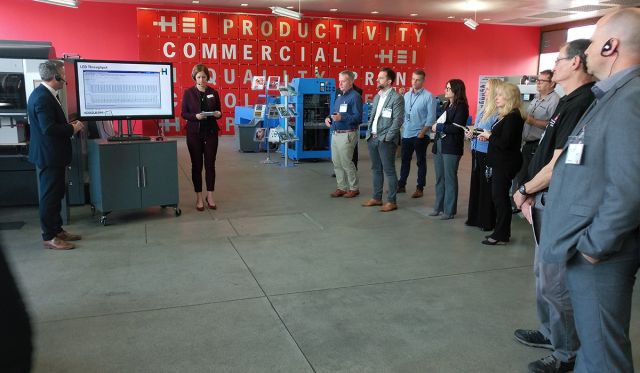
Heidelberg demonstrated two rapid makeready presses during last week’s open house at Brentford, one featuring press to stop technology, the other running with LED UV curing.