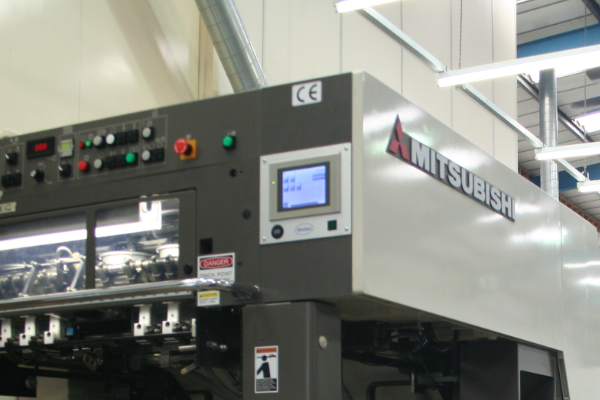
Mitsubishi Heavy Industries has written to customers telling them that it is withdrawing from the newspaper press market. The company remains committed to its share in RMGT, the sheeted press business that combined the interests of Mitsubishi and Ryobi ten years ago.
There is no partner, however, for the newspaper and web offset press side of the business. The company has announced that it will cease to build presses once current orders have been delivered. The move will leave TKS as the only newspaper press manufacturer in Japan, reflecting the shrinkage too in both newspaper and web offset press orders in Europe and elsewhere what few deals there are are shared between Koenig & Bauer and Manroland Goss.
MHI has told customers that it will continue to maintain and service machines until 2036. This has not prevented anger among some customers.
While circulations in Japan have been hit like elsewhere, newspaper reading remains huge in the country. The Yomiura Shimbun, which has around 40 Mitsubishi presses, produces more than 6 million copies a day. The Hokkaido Shimbun, a regional daily for the northern island, distributes 763,000 copies a day. It bought three Mitsubishis as recently as 2017.
The manufacturer has had almost no impact in Europe, though at the turn of the century with expansion in the air, Mitsubishi was selling heatset web offset presses with two installed at Roularta in Belgium. They have since been replaced by Manroland presses.
However, Mitsubishi Heavy Industries retains a foot in the door with its corrugated handling systems. This includes the launch of Compox, a unit to produce entirely bespoke three dimensional box from corrugated sheets. There is currently no printing element to this.
The Compox machine is aimed at distribution and ecommerce businesses and will produce ten fully formed boxes a minute, helping to reduce manpower, increase space efficiency on trucks and so reducing carbon emissions from transportation. Deliveries will begin next month.