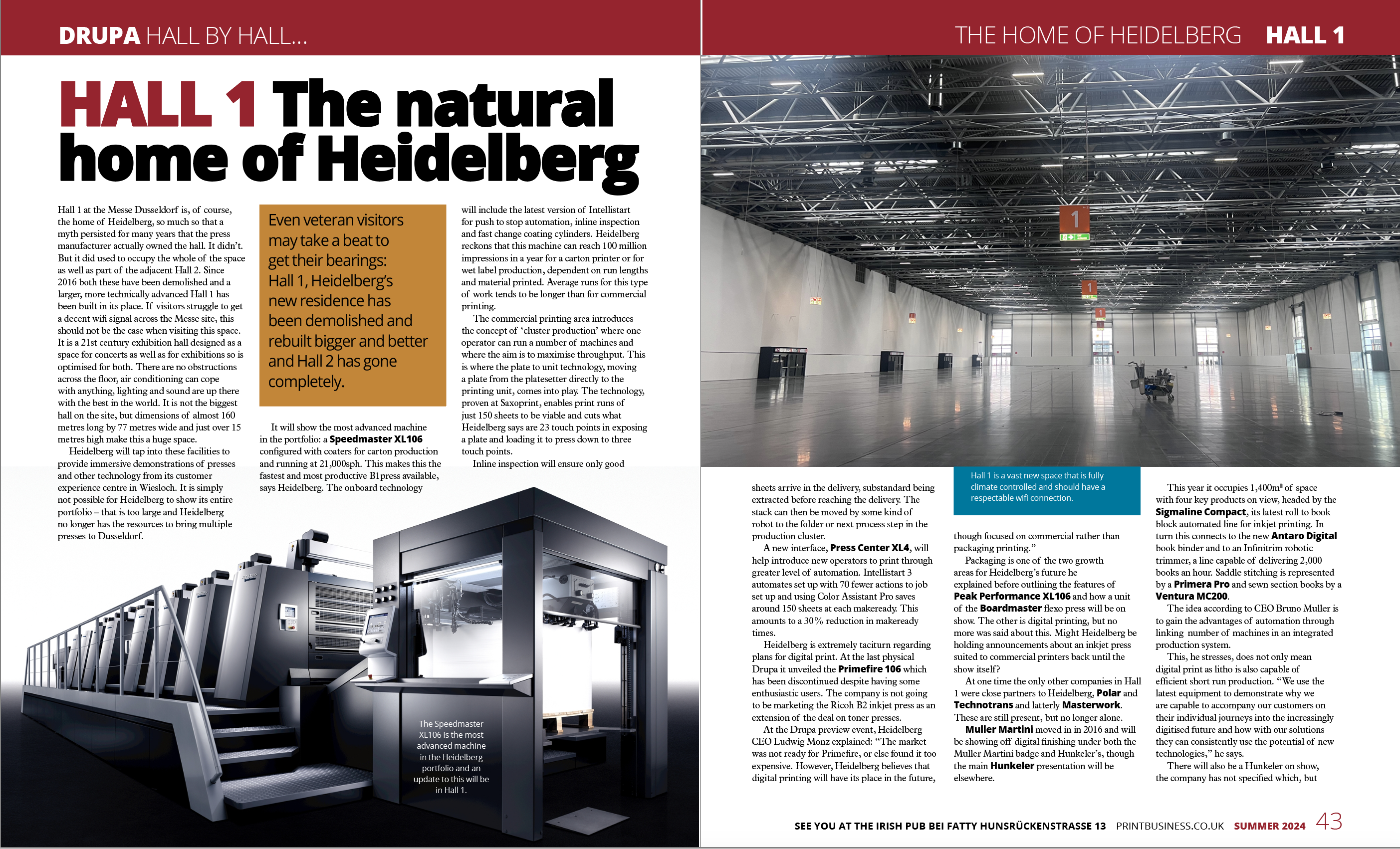
Hall 1 at the Messe Dusseldorf is, of course, the home of Heidelberg, so much so that a myth persisted for many years that the press manufacturer actually owned the hall. It didn’t. But it did used to occupy the whole of the space as well as part of the adjacent Hall 2. Since 2016 both these have been demolished and a larger, more technically advanced Hall 1 has been built in its place. If visitors struggle to get a decent wifi signal across the Messe site, this should not be the case when visiting this space. It is a 21st century exhibition hall designed as a space for concerts as well as for exhibitions so is optimised for both. There are no obstructions across the floor, air conditioning can cope with anything, lighting and sound are up there with the best in the world. It is not the biggest hall on the site, but dimensions of almost 160 metres long by 77 metres wide and just over 15 metres high make this a huge space.
Heidelberg will tap into these facilities to provide immersive demonstrations of presses and other technology from its customer experience centre in Wiesloch. It is simply not possible for Heidelberg to show its entire portfolio – that is too large and Heidelberg no longer has the resources to bring multiple presses to Dusseldorf.
It will show the most advanced machine in the portfolio: a Speedmaster XL106 configured with coaters for carton production and running at 21,000sph. This makes this the fastest and most productive B1press available, says Heidelberg. The onboard technology will include the latest version of Intellistart for push to stop automation, inline inspection and fast change coating cylinders. Heidelberg reckons that this machine can reach 100 million impressions in a year for a carton printer or for wet label production, dependent on run lengths and material printed. Average runs for this type of work tends to be longer than for commercial printing.
The commercial printing area introduces the concept of ‘cluster production’ where one operator can run a number of machines and where the aim is to maximise throughput. This is where the plate to unit technology, moving a plate from the platesetter directly to the printing unit, comes into play. The technology, proven at Saxoprint, enables print runs of just 150 sheets to be viable and cuts what Heidelberg says are 23 touch points in exposing a plate and loading it to press down to three touch points.
Inline inspection will ensure only good sheets arrive in the delivery, substandard being extracted before reaching the delivery. The stack can then be moved by some kind of robot to the folder or next process step in the production cluster.
A new interface, Press Center XL4, will help introduce new operators to print through greater level of automation. Intellistart 3 automates set up with 70 fewer actions to job set up and using Color Assistant Pro saves around 150 sheets at each makeready. This amounts to a 30% reduction in makeready times.
Heidelberg is extremely taciturn regarding plans for digital print. At the last physical Drupa it unveiled the Primefire 106 which has been discontinued despite having some enthusiastic users. The company is not going to be marketing the Ricoh B2 inkjet press as an extension of the deal on toner presses.
At the Drupa preview event, Heidelberg CEO Ludwig Monz explained: “The market was not ready for Primefire, or else found it too expensive. However, Heidelberg believes that digital printing will have its place in the future, though focused on commercial rather than packaging printing.”
Packaging is one of the two growth areas for Heidelberg’s future he explained before outlining the features of Peak Performance XL106 and how a unit of the Boardmaster flexo press will be on show. The other is digital printing, but no more was said about this. Might Heidelberg be holding announcements about an inkjet press suited to commercial printers back until the show itself?
At one time the only other companies in Hall 1 were close partners to Heidelberg, Polar and Technotrans and latterly Masterwork. These are still present, but no longer alone.
Muller Martini moved in in 2016 and will be showing off digital finishing under both the Muller Martini badge and Hunkeler’s, though the main Hunkeler presentation will be elsewhere.
This year it occupies 1,400m2 of space with four key products on view, headed by the Sigmaline Compact, its latest roll to book block automated line for inkjet printing. In turn this connects to the new Antaro Digital book binder and to an Infinitrim robotic trimmer, a line capable of delivering 2,000 books an hour. Saddle stitching is represented by a Primera Pro and sewn section books by a Ventura MC200.
The idea according to CEO Bruno Muller is to gain the advantages of automation through linking number of machines in an integrated production system.
This, he stresses, does not only mean digital print as litho is also capable of efficient short run production. “We use the latest equipment to demonstrate why we are capable to accompany our customers on their individual journeys into the increasingly digitised future and how with our solutions they can consistently use the potential of new technologies,” he says.
There will also be a Hunkeler on show, the company has not specified which, but this will be integrated to Muller Martini’s Connex workflow, having settled on a standard electronics platform.
Muller Martini will also be sprinkled across the exhibition: with Vareo binders and similar operating to show end to end production with digital print technology.
There will be opportunity for a direct comparison between Muller Martini’s solutions and those from the very much smaller Meccanotecnica business. It has designed and built its own Sirio bookbinder, able to handle book of one production, blocks for case binding and thus competing with the Vareo.
Like the Vareo, Meccanotecnica’s machine has three independently control clamps. The cover feed has a creasing shaft for each side of the cover and can cope with covers with fold out flaps. The self contained book production unit delivers fully trimmed finished books.
The Swiss and Italian companies already compete on thread sewing. Meccanotecnica’s Universe sewer will be one stream into the Sirio and its automated three knife trimmer. Its Aster sewing machines are targeted at offset production.
Before buying Hunkeler, Muller Martini had acquired the Kolbus book binding interests since the 2016 Drupa. However. Kolbus continues to produce case making machines and especially packaging, both corrugated and rigid board boxes. It has also designed and launched the RD115S, a flexo press for corrugated board, but this will not be at the show. Instead Kolbus promise a virtual reality experience to introduce this to customers.
The key product on show will be a complete box making line from flat board which is scored, cut slit, punched, folded and glued. The BX Motion Pro is designed for short run production with a full changeover possible in 60 seconds.
This is joined by a rigid box production line with wrapping, folding and gluing for luxury packaging applications. Traditional book customers get the DA370, the latest version of the casemaker.
Managing director Wilfried Kröger says: “With our new orientation, we want to highlight new business areas and talk about possible partnerships. An interactive media project, to be premiered at the Drupa, will let visitors explore the potential we see for our machines in future flexographic printing and die-cutting technology for sustainable packaging production.
“On our stand, extended reality will let people experience the progress of printing and die-cutting technology and explore new possibilities. We want to build partnerships with our target groups by showing not only how our machines perform, but also their potential to improve our partners’ processes and contribute to their success.”
Kolbus’ presence in Hall 1 is a move for the business from its previous locations. Not so for other companies with close links to Heidelberg.
Polar has had to undergo reorganisation following a cash flow crisis. Its focus is on automation and the concept of the ‘connected customer’. Guillotines and other cutting units will feed job status information back to the production hub, while there is a focus on how AI will manage job scheduling, provide advice on maintenance and linking to digital workflows, for high volume web to print customers for example.
With the ongoing difficulties in recruiting staff, automation of handling around the cutting blade becomes more affordable.
Before the financial challenges, Polar had been investigating the use and applications for laser cutting. How this will be shown, remains to be seen.
IST has been a provider of UV drying technologies to Heidelberg for many years. It will introduce Freecure, a UV curing technology that overcomes the need to use photo initiators. This uses high powered UV-C lamps, originally developed for use in sterilisation, in collaboration with technology developed by BASF which reacts with the UV-C lamp to create the cross linking between polymer chains that trap the ink and produce the hard and dry finish to inks and varnishes.
Like highly tuned LED UV, there are no VOCs from this technology and as a key advantage it works with water based inks and varnishes. This opens up vast potential in flexible packaging where electron beam has been used to avoid the need for photo initiators. Water based consumables are needed for food safety regulations and IST believes that Freecure meets the requirements for GMP guidelines.
The Freecure unit is a cassette containing the lamp, cooling and the specially designed reflectors which bounce the UV energy to where it is required while filtering out IR. For any printer looking at packaging, whether cartons, corrugated or flexible, understanding the implications of this development is essential.
Technotrans is another of Heidelberg’s long standing partners that by tradition exhibits close to its customer. The company long ago spread beyond chilling systems for fount systems into systems that are used to control the temperature of ink rollers and on digital presses.
This time around Technotrans will emphasise use of R290 as a coolant. This is an environmentally friendly product that is used in systems where reduction in energy consumption is essential. This ranges from fount solutions and ink roller cooling to systems for managing the operating temperature of digital and flexo presses, combining drying and cooling systems to ensure that waste energy can be captured and reused.
Others in Hall 1 include Heidelberg partner Masterwork for die cutting, foil blocking and carton folder gluing. In the same sector, though aiming at lower volumes, is Kama with a promise of digital foiling to come.
Italian supplier SCS Automaberg will launch the DCH60 die cutter as a machine designed for digital print to the maximum of B2 sheet.
Ideal and EBA have the small format guillotines to reflect Polar on the larger formats. The remaining companies are from China, one from Turkey, and so are unlikely to have any appeal to the UK visitor.