
Heidelberg is creating a ‘state of the art’ research facility within one of the manufacturing halls at its Wiesloch plant. It will be large enough to accommodate up to 1,000 staff.
When the €50 million innovation hub is fully occupied in 2018, the company will only have a handful of staff in the centre of Heidelberg itself. The unit will employ engineers, around 250 software specialists and chemists who are developing inks needed for its inkjet operations, represented by the Omnifire UV machines and aqueous Primefire 106 press.
As this and the <a href=”Labelfire use Fujifilm inkjet printheads, that company’s inks have been used to date. Heidelberg is now producing its own environmentally friendly inks for numerous new applications, it says without further explanation.
The move will reduce the company’s outgoings, and will also bring the development teams closer to the manufacturing, demonstration and service operations. The company has a strong commitment to Industry 4.0, requiring close integration between mechanical and software development to create what Labour Party leader Jeremy Corbyn notably called “cyber physical systems” last week.
The project was launched by incoming CEO Rainer Hundsdörfer and Theresa Bauer, minister of science, research and the arts for Baden-Württemberg, Heidelberg’s home state. She says: “The example of Heidelberg is demonstrating that even a large company can reinvent itself.”
While the printing press giant is not yet generating the profits that it once did, the company is on an even keel. It is aiming to achieve mid term sales of €3 billion annually, growing at 4% a year for the medium term. This will come from digital printing, consumable sales, including its own inks, and service, each of which will benefit from the investment in R&D.
Stephan Plenz, board director with responsibility for equipment, says: “Combining development, service and production at a single location close to the customer will make us even faster and more efficient in the future.”
The existing facility is adjacent to the former head office and showroom in the centre of the city, and spreads over several floors including presentation theatre. Access to the lower level where prototype machines have been put through their paces is strictly controlled.
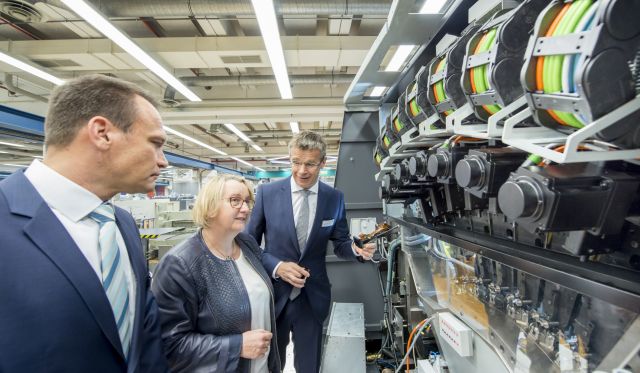
Heidelberg is moving its R&D facility to the Wiesloch factory, a move welcomed by Theresa Bauer, minister at the state government of Baden-Württenberg as proof that Heidelberg is back.