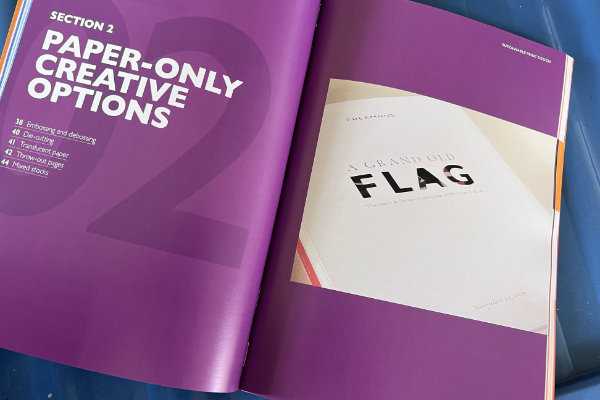
Park Communications has published Sustainable Print Design as a guide to magazine and book publishers to the sustainability of the paper, print and finishing choices they make.
It is a response to a rapidly growing interest in sustainability among the Park customer base of independent publishers and designers. And the publication itself lives up to the promise by being produced with renewable energy, part recycled papers and carbon generated in production is offset through Climate Partner.
In the introduction, the guide sets out its purpose: “Dozens of individual choices make up a sustainable print production, ranging from the choice of paper and materials to factors such as its paper size and choice of processes. Print designers are increasingly called upon to guide their clients through the choices while also delivering in the wide range of objectives for the production…This book is intended to simplify these choices.”
The book uses Symbol Freelife satin 40% recycled and the cover of Freelife vellum 40% recycled/5% cotton. Both are Fedrigoni papers.
Park Communications managing director Alison Branch says: “The majority of customer enquiries these days start with questions about sustainability, yet to date, there has been no comprehensive resource on the papers, processes and other materials that make up a sustainable print production. This book is intended to answer that need.”
It is split into three sections: print and finishing; paper only creative options and paper. The first examines choices in binding, glues, varnishes laminates, foiling and enhancements through other print finishes.
The creative options for finishing include embossing and debasing, die cutting, translucent papers, throw outs and mixing stocks. The paper section deals with recycled and part recycled papers and alternative fibres including leather, coffee cups, cotton and wool.
The East London company does not condemn laminates or foils because in the recycling process these are easily separated from the paper and can be filtered out from the pulp fibres. The recycled paper that results has the advantage of requiring less water and energy to manufacture, but is two to four times more expensive than virgin fibre equivalents can be more demanding to print on. The virgin fibre papers that Park uses are FSC certified, ideal for art and fashion products and offer a far wider range of colours, weights and sheet sizes than recycled materials.
The options at every stage are presented with cost and impact assessments as well as telling designers whether the process contains plastic or mineral oil and whether it affects recyclability.
The publication is intended to be neutral and offers advice to designers to select printers that source their energy from renewable sources, that has ISO 14001 or “even better works to the Emas certification”. Park naturally hits these spots, working to the Emas standard even if post Brexit, a UK company cannot hold what is an EU certificate.