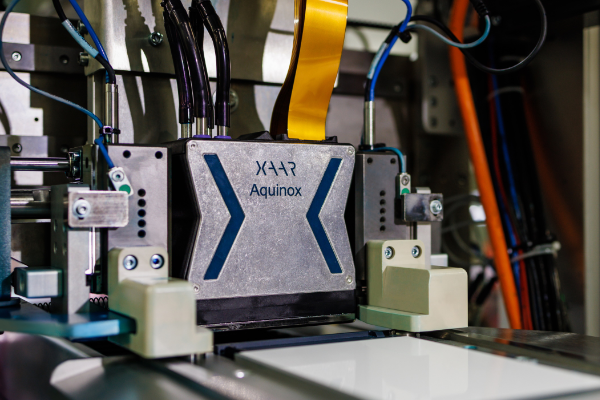
Xaar has started to ship its breakthrough water based printhead, Aquinox, claiming the ability to jet viscous water based fluids will be transformational.
The printhead has been undergoing testing, internal and with beta customers, for a year. This has given Xaar confidence to reveal the full specifications and technology in the printhead and to announce that it can supply full test kits. These will be used by OEMs to validate the technology and its suitability for new products. It will be up to two years before any on the street products are announced, says Xaar CEO John Mills.
“This has been an exciting day,” he says. “We have been talking about this development for a couple of years.”
Those products are likely to include ceramics printers where end users want to shift to water based inks but have been stymied by an inability to print a viscous fluid. There is interest too from corrugated and flexible packaging. For the one, less water means better quality and a reduced drying requirement, for the latter it opens the possibility of printing on non absorbent substrates, such as films.
“Aquinox is superior to other aqueous products on the market. The accepted way has been with high water content inks which require a lot of energy to dry the substrate. A lot of people have wanted to use water based inks but the constraints have been so significant. That is why this is so transformational.
“It can lay down more pigment so you get twice as much colour, you can print twice as fast and you don’t have to dry it as much because there’s less water.”
A key sector will be textiles where transition to inkjet has been slowed by a lack of suitable technology. The Aquinox head can cope with the low pH inks that are needed for textiles, it can print with either dye or pigment inks and the reduced water component relative to colour, means a radical reduction in energy needed to dry the inks.
The ability to print viscous fluids points to being able to
The printhead continues in the same vein as previous Xaar piezo printheads with through flow technology to keep nozzles open even for extended periods. This included over a weekend when the press was closed off. It started up on Monday morning without a hitch, says Mills. This means too that the head will be resilient in low humidity situations, exhibition halls included, which affect the ability of water based heads to run smoothly.
Resolution is 720dpi with a firing rate of 48MHz, though with the ability to fire droplets with twice the pigment load, this enables the printhead to run faster and speeds of 100m/min can be achieved. BOth specifications leave scope to develop finer resolution and faster printheads in future.
It is a case of taking areas where in the past Xaar has been criticised and turning these into a benefit and strength rather than a weakness, says Mills. ”We have addressed these perceived weaknesses and have overcome them so that they are no longer a barrier to adoption.”
The electronics have been redesigned to protect them from moisture. This, along with ink supply and print heads, will be part of the development kits, intended to make it easier to assess the technology prior to adoption.
“This is like the transformation between cathode ray tube televisions and flat panel screens, from film photography to digital,” says Mills. It is not going to happen overnight but will be a transition over the next 10 years with Xaar once again at the heart of the change. “Over the next five years ink companies will need to differentiate their products to gain market share
The company can cope with demand. Over the summer it has reorganised internally to be able to produce three times as many heads and there are plans to increase capacity should these be needed.