
The advent of new generation UV technologies has added a new twist to the decisions a UK printer must take when deciding on a new press, says Heidelberg UK sales director Jim Todd.
Heidelberg can offer tuned mercury vapour lamps with LE (for Low Energy) UV and now LED UV and can demonstrate both at its Brentford showroom. And it can offer fast drying inks and coatings to deliver if not a fully dry sheet, then one that can be finished “maybe faster than some would imagine is possible”.
To date Heidelberg has not shipped as many machines as other manufacturers, but is poised to catch up. A first installation will take place at Wincanton Print with an XL75 LE-UV press, where there are three Komori H-UV machines nearby and KBA has installed a Rapida 105 with an LED-UV system. It will not be alone for long, says Todd.
“We are having conversations about both technologies and have been close to signing other deals,” he says. “One walked away because he didn’t like the finish from the UV inks.
“The UV inks, whether LE or LED, are still three times as expensive and will not fall to match the price of conventional litho inks, but you can buy a four-colour press rather than a four-colour plus coater; you do not use a seal which saves money, you do not use spray powder which is popular in the finishing department. And there are significant savings in the amount of energy needed to dry a sheet.
“LE-UV is not for everybody, nor is LED. There is evidence that less ink is needed; with a coater, a printer can deliver drip off and other varnish effects so it provides an opportunity for a greater variety of added value work, including printing on plastics.
“We need to make sure that the market is aware, but it’s impossible to say which way a printer should go without understanding the full costs and strategy of each printer.”
Heidelberg put this on view last week at a two-day open house to demonstrate the choices that a printer might make to deliver ‘rapid response’. It involved combining a section printed and folded on the SX74 fitted with both forms of new generation UV and sections printed on the Linoprint digital presses. The sheets were loaded in collated order in a Muller Martin Presto Digital stitcher. The litho printed section was fed through a conventional hopper. From delivery of the press to deliver from the finishing line had taken seven minutes.
“We wanted to show people ways to get stuff out of the door fast. This has been where digital has been attractive to customers because it lets them deliver a product quickly. There are always questions about the breakeven point between litho and digital, and litho is always cheaper per sheet, but until now by using digital a printer can be finishing a job while waiting for the litho sheet to dry.
“We wanted to get people to come and see the opportunities for litho to deliver a dry sheet.”
Heidelberg has inks for either UV technology within its Saphira consumables range. It has so far supplied LED inks to customers in Japan, while LE has proved popular in Switzerland. Heidelberg UK has been responsible for installing an eight-colour LE equipped machine at Lasertryck in Denmark, a company which has subsequently bought standard litho presses to handle longer runs.
Equally important in the ability to deliver a finished product, where the partnership with Muller Martini steps in. The Swiss company is beginning to gain traction for its Digital range of binders and stitchers. The Presto Digital is a conventional stitching line with the addition of a plow folder and accumulator at the start of the gathering chain.
Ahead of this is a Stahl folder which folds the flat sheet in half, with the plow folding it again. A selected number of sheets is held at the gate before dropping on to the saddle and progressing in the normal way, adding preprint sections and a cover section before stitching and the three-side trimming. Further developments to the sophistication of product will come next year.
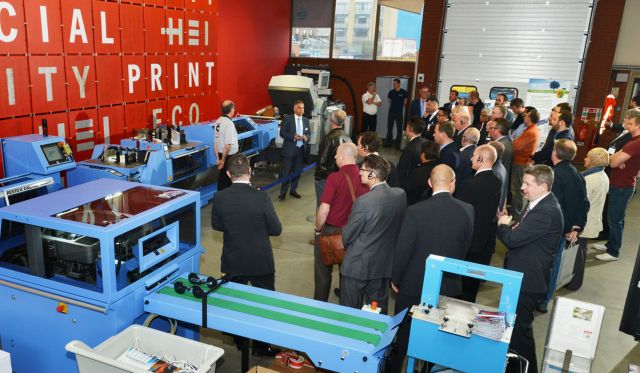
Heidelberg demonstrated its LED equipped Speedmaster SX74 at Brentford last week to show that a combination of litho, digital and a smart stitching line can result in high speed turnaround for print.