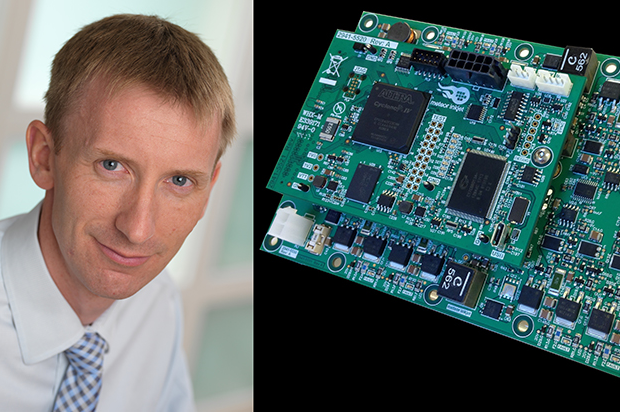
Meteor Inkjet has redesigned its print controller card to compensate for the global shortage of specialist computer chips.
The company has supplied hundreds of the print controller cards, used to regulate the flow of image data from a PC to a wide range of inkjet printheads, to customers around the world. But dependence on a particular microprocessor put delivery of £4 million of printhead drive electronics at risk with knock on effects for end user projects and applications.
The Meteor controllers are used with many printheads, from Xaar to Fuji Dimatix, Epson to Konica Minolta, Ricoh and more. These end up in custom integrations and standalone inkjet presses for large format to label printing, among them Dantex’s PicoColor label press.
Rather than wait until until shipments of the key component were missed, Meteor says it embarked on a fast track project to reengineer the controller board using a chip that was plentiful. The Cambridge company ordered more than a year’s supply even before the project kicked off.
It is now shipping the PCC2 in production quantities, making up for the delays that had built up in the last six months. Vice president business development Jonathan Wilson says: “Our customer base, having grown over the last decade to make Meteor the largest datapath supplier in the industry, had to wait for us to find a solution to what continues to be the worst chip supply shortage ever. I am delighted that their patience is now being rewarded, and we will quickly clear the order backlog that developed over the last two quarters.”
Dantex Digital is among those customers. It worked closely with Meteor to validate and test the new controller during its development, acting as a beta customer.
There has also been a gain for these customers. The PCC2 is faster and has greater potential for functionality enhancements. But the greater immediate impact is that projects are back on track. Meteor managing director Clive Ayling says: “It is a source of immense pride for everyone at Meteor that this enormous task has been achieved. In particular, praise is due to our engineering team in Cambridge who pivoted their attention to this one project which has resulted in a robust, backward compatible replacement product for our customers in record time.”