
Platesetters have come in all sorts of shapes and sizes, from the early monsters developed by Creo, to deadends like the ICG flatbed, the Crosfield Electronics turtleback concept, the Linotype-Hell train, the Highwater barbecue to the frankly bizarre Luscher concept of imaging a flat plate in a spiral rather like a record player’s needle traversing the vinyl disc.
Equally there were branches sprouting off the evolutionary tree in terms of plate technology. Few will remember Howson-Algraphy discovering that a fully processed blank plate might be imaged by using the laser to blast away unwanted parts of the surface.
Creo, shortly before its acquisition by Kodak, demonstrated a new style of processes plate and discussed the idea of reusable plates by adopting phase change technology to alter a coating from hydrophobic to hydrophilic.
Process-free plates are now common place, though single-use only. They are undoubtedly increasing in popularity, but like other forms of thermal plate technology, remain expensive to buy, if not to use. Likewise Presstek’s ablative technology remains in a niche if not a backwater, while thermal plates exposed by 830nm lasers have become the industry standard.
Platesetter designs are standardised, helped by the reduction in the number of suppliers. Commercial print machines sold by Fujifilm and Agfa are produced by Screen, which also sells them. These are external drum machines with inbuilt plate punching as is the Heidelberg Suprasetter design, Kodak’s designs are refinements of machines acquired from Creo or Scitex and follow the same rules.
It might seem as if innovation has ended, that it is not worth others trying to come up with new ideas. That will not stop some trying, looking the accepted way of doing things and trying to disrupt this.
For example, why use thermal lasers and plates when UV sensitive plates are considerably less expensive? It has been tried before. Xeikon subsidiary Basys has had some success with the UV-setter, especially in very large format applications where the difference in the per square metre cost of the different plates can have a significant bottom line impact.
Likewise Luscher developed a version of its internal drum machine to run with a UV sensitive laser. Esko tried to market a computer to conventional plate system, believing that a low cost unit would appeal in the emerging market economies where conventional plates were plentiful, but CTP plates scarce and expensive. It did not work.
Apex Digital Graphics managing director Bob Usher knows why. While plates were available and effective when exposed in contact frames from separated films, they were not consistent enough for exposure in platesetters. The quality was dictated by the film not the plate. There had been no pressure for either greater batch to batch consistency or across the plate area on conventional presensitised plates.
Thermal CTP plates on the other hand had always been made with greater precision.
The Cron Blackwood plate factory in China has been built with this precision in mind and to match the Cron platesetter which is available with either a thermal laser or one to expose UV sensitive plates.
This has ended up with Apex Digital Graphics in the UK on what is possibly its third attempt to expand into Europe. Earlier machines had technology which was not adapted to the European market, Usher says, but they were suited to Asian markets where labour is plentiful and automation not a requirement.
That has been addressed with inclusion of European levels of automation, namely interleaf removal, punching and a bridge to carry the plates to a processor or stacker.
But rather than repeat what has become accepted as the norm because it was the only way to do things previously, Cron has revisited those assumptions, says Usher.
The punching is carried out on the bridge after imaging, not inside the platesetter where there is an admittedly small risk of the discarded pieces of plate finding their way into damaging areas. There is more danger of a slight bounce skewing the plate as it drops into the clamp on the platesetter he points out.
With the post imaging punch, the plate can be moved into position according to imaged register marks. If the image position has shifted a fraction, cameras are used to ensure the position is correct for on press registration.
The bridge can also work with two types of plate. A plate which needs processing, such as Fujifilm’s L-PJ plates will carry on to a processor while a develop on press plate like Fujifilm’s Pro-T3 is turned and directed to a stacker away from the processor. It becomes a fully automated plate line that can fit into the corner of factory and allows a printer to run different plates according to press or need.
The develop on press plate will have higher environmental credentials, but a shorter press life; the standard thermal plate needs chemistry, but is far more durable. More durable still is the UV exposed conventional plate.
The same design of platesetter can be fitted with UV diodes instead of red thermal lasers to employ the same design for moving plates through the process. Likewise the cassette trays holding the plates provide the machine with rigidity and a simple modular approach which means the design can be scaled up for larger machines or down for smaller. The result is that a platesetter can hold three different plate types or formats, feeding from each as dictated by the workflow.
In the UK this is provided by FFEI which developed the original Fujifilm XMF workflow, so there is a shared heritage between the two and it is a proven workflow system.
The number of diodes employed in the platesetter can also be varied, from 16 at one end to 98 at the maximum, to adjust the output performance of the platesetter to match the customer’s requirement.
While the Cron will image conventional plates from other suppliers, its own plates have the close match which comes from a joint development, and so are preferred. They are considerably less expensive than a thermal or even a violet sensitive CTP plate.
This will be key to the marketing approach, Usher explains. Apex still has multiple users of the old DPX polyester plate system that was packaged with many Ryobi press sales, especially of Ryobi 3304s.
Today a large portion of that market has been subsumed into digital printing. However another part has moved on to more sophisticated litho presses, with the Ryobi 520 or Ryobi 750 models for example.
These are now the customers intrigued by the possibilities of digital litho, printing with LED UV, to offer one of the main benefits of digital printing without losing the advantages that litho has on longer runs.
The harsher on press conditions with UV inks has its impact on thermal plates reducing run length for develop on press plates significantly. Presensitised UV plates fare much better, at least until plate manufacturers can come up with more robust coatings.
Usher reckons that there are 130-150 printers using the now outdated DPX system. “They are going to need something else and now that Cron can offer the automation that is needed, it becomes a viable option,” he explains.
Cron is also key to litho being able to compete with digital in terms of turnaround, Usher explains. A customer operating a B3 LED UV press has run the numbers in comparison to a Xeros iGen. “Sheets on the floor from the LED press are costing .2p compared to 2.5p from the Xerox digital press,” says Usher, “meaning that litho becomes less expensive above 130 sheets.
“The printer also has a press which after five years has a retained value, which is not the case with a digital machine. We have calculated the full figures, press costs, maintenance, expectations of machine availability and so on.”
It convinced the northern customer which eliminated the costs of putting litho work out and ate into the work that had been marked for digital printing, Usher explains. And will continue to explain the logic during the second series of Print Efficiently days and well beyond.
Litho’s fightback against digital is well underway.
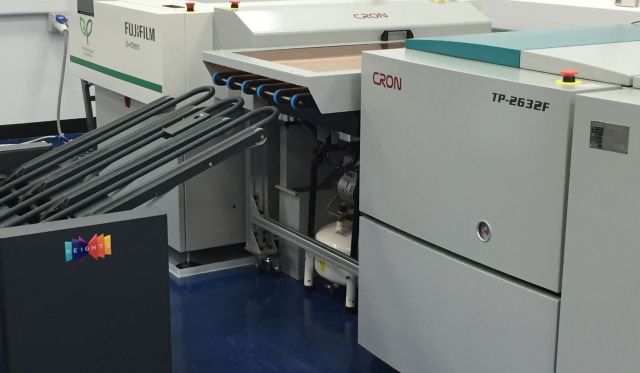
The Cron platesetter is built to a different design to the external drum approach that seems to have become the standard across the industry. This allows a modular approach to the speed and the types of plate that can be imaged.