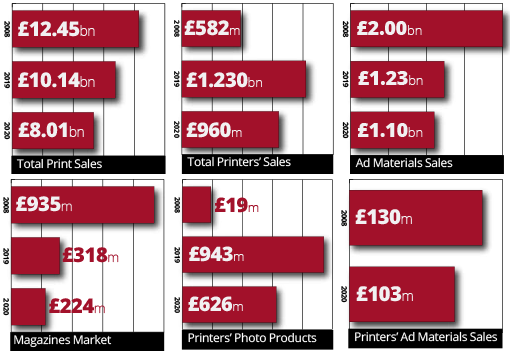
Books, labels and cartons were the shining lights for print during the first Covid year, according to UK government statistics, while catalogues, advertising and stationery showed the sharpest declines. Given that the year was marked by lockdowns, work from home and furlough, the findings are not unexpected. Given too that these were among the sectors that have been in flux for many years, the findings are not unexpected.
What matters is how individual printers respond. For many it has been to hunker down and hope that the troubles will blow through and that business will return. For some it has been too late, companies have closed, merged or become insolvent and unable to carry on.
The IPIA reckons that 90 of its BAPC members, in the main high street copy shops, have ceased trading for one reason or another. And the rate of attrition in commercial print is hardly any less. The London Gazette records that around 250 printers appointed liquidators, were would up or went into administration during 2021.
This was less than the worst predictions. The IPIA feared in August that another 3,000 companies would close and another 3,000 would follow in the coming months without government assistance. The BPIF in its reports to BEIS were hardly more optimistic, predicting the demise of hundreds of printers.
That not too many have fallen off the perch is not much of a relief, There is belief that the can has only been kicked down the road and that some time in the first half of this year, more companies will be forced to close or to merge.
While the ONS data relates to the 2020 calendar year, it is a sobering read. The BPIF estimates that printers lost 40% of their order book when the country entered the first lockdown. They recovered, but lost orders could not be recovered.
By the end of the year, total industry sales had dropped around 20% from £10.14 billion in 2019 to £8.01 billion in 2020. This is only two-thirds the value of the print produced in the UK in 2008 when the ONS records sales of £12.45 billion. Sector after sector, especially those reliant on long run commercial work, fell back.
The value of stationery dropped from £1.07 billion to £785 million between 2019 and 2020 having enjoyed a very shallow decline from £1.16 billion in 2008.
That drop can be attributed to work from home, the lack of facemask to facemask meetings contributing to declines in demand for letterheads, comp slips and especially business cards. Unless there was a very good reason to replace cards that were not being used, a corporate redesign or new job role for example, business cards were not being used. There were no exhibitions, no conferences and no meetings where by convention cards are exchanged.
Likewise without events and without shops or restaurants, there was less need for flyers. The value of flyers produced in 2020 was £243 million, down from £330 million in 2019 and from £650 million in 2008. This does not necessarily reflect a decline in the volume of flyers being printed as this product was very much in the sights of online printers based in Germany and elsewhere operating at much lower prices that an independent litho printer could offer.
The same phenomenon has struck general advertising material which had been worth more than £2 billion alone in 2008, which had dropped to 1.23 billion by 2019 and £1.1 billion 12 months later. The catalogue sector lost more than two-thirds of its value in these years, dealing from £559 million in 2008 to £173 million and then £147 million. This loss of market helps explain why web offset and long run sheetfed printers have diminished.
Magazines are also not what they were. A market that the ONS valued at £935 million in 2008 had become worth £224 million in 2020, dropping more than 25% in a year from £318 million in 2019.
These have been among the traditional markets for print and which have underpinned investment by printers large and small for decades. Now it would appear that a printer pinning hopes in one of these sectors, unless extremely efficient or financially strong enough to become the last man standing, must struggle.
There have been winners while the commoditised sector of the industry becomes a swirling bath of red as those in it fight to the death – figuratively of course. The most obvious of these is book printing. Even before the pandemic struck book printing has been the most striking success of recent years.
Overall sales for printers grew from £582 million in 2008 to £1.15 billion in 2018 and then £1.23 billion in 2019 before falling back to £960 million in 2020. This is almost certainly the result of shops being closed, forcing book buyers to shift online.
While 2021’s statistics for print are not yet available, it would appear that book production has continued its upward path. First the year was a bumper one for book sales with more than 212 million books sold, the most for a decade and reaching £1.8 billion by value.
Fiction titles led the way with a 20% growth. This is good news for UK print as most fiction titles are printed in this country. In non fiction the wellbeing category of mind, body spirit experienced the biggest growth – perhaps unsurprisingly given the circumstances of the pandemic. Nielsen, which collects the data on book sales, says: “One thing we can be certain about: books are most definitely not a pandemic fad and have proved their lasting power time and again.”
Other sectors will be wondering if their recent success is a pandemic fad and whether the sharp rise in internet shopping at the expense of the high street, is here to stay.
Book publishers are also in the front line of sustainability, many considering ways to measure the carbon footprint of individual volumes and all pledging to become more sustainable beyond Scope 1 and Scope 2 activities. This means consideration of where production is carried and means too ways to reduce waste inherent in extended supply chains. Book production is headed home, though a lack of capacity for coloured books in volume may restrict how fast this can happen in non fiction and children’s literature.
Certainly demand for corrugated packaging has soared along with folding cartons and labels. People forced to stay at home have driven a growth of superior takeaway food, of restaurant style meals that can be completed at home and of multiple subscription services for food. All require strong elements of print that did not exist prior to lockdowns. Online shopping for food, if it continues, could have a profound effect on the growing awareness of packvertising, using the packaging as a point of persuasion for consumers. There is no point in a consumer searching for a bottle of a fizzy sugary drink with his or her name on it if an unknown worker or robot selects a random bottle to complete an order placed via an app.
Zoom calls may have helped book sales as a well stocked and varied library says more about the user than any computer generated background. Stay at home rules meant greater spend on home decor, potentially on bespoke fabrics and textiles and on designer wallpaper, costing up to £800 a roll in some cases. Wallpaper printing in the UK is a £103 million a year sector, which is down on the £130 million it was worth in 2008, though higher than more recent years. Again 2021’s data may show a further increase.
The greetings cards sector has, like books, gained as publishers return work from the far east, though losing sales thanks to the forced closure of high street outlets. This led to a big swing towards online sales for greetings cards, though not enough to compensate for sales lost on the high street. A sector which has been worth around £77 million a year for ten years or so, dropped to £62 million precisely because shops were forced to close.
And the photo product market, doyenne of the internet, suffered a set back in 2020 with sales falling around a third from £94.3 million in 2019 to £62.6 million in 2020. This is still much higher than the £19.0 million recorded in 2008.
The ONS has only in recent years included a value for textile printing and for printing in other industrial applications, including printed electronics. There is room for further sectors to be added should new printed products emerge over the next few years and so help disguise the decline of mass customisation print.
On the other hand the statistics still include data for maps, for dictionaries and encyclopaedias which have all but vanished in print versions at least.
The year under review can be described as an exceptional year, but the direction of the figures over the previous decade indicate that the pandemic accelerated but did not alter the direction of travel.
Printers in terms of assessing their own business strategies need to be aware of the statistics, and while the shrinkage of the industry may help mitigate some of the worst impacts of declining markets for those that survive, the data does not point to sunlit uplands – at least in the majority of the traditional areas that print has served until now.
Print was already a fast changing industry. That change has just sped up.