Matt Dahan recalls exactly where he was when the light bulb inside his head flicked on. He had quit his job with an online retailer where he had been focused, literally, on creating product images for the website in order to go travelling for a year.
He arrived in Australia armed with his camera. As a keen photographer he was building a journal of his travels and had taken a picture of Sydney harbour at sunset. Staying with a family in the city, he wanted to have the picture printed as a large format canvas wall art image as a thank-you for hosting him. When the image arrived he was utterly disappointed. “The colours were not accurate. The people printing it clearly did not understand the importance of colour accuracy. And it was pixellated,” he says. “That was the lightbulb moment.”
Dahan understood what the Australian printer had not. The company had processed a digital file, the customer wanted a reproduction of a photograph with faithful rendition of colours and a smooth finish. Dahan could use his photography experience, combined with his knowledge of online retailing to build a print company to avoid the disappointment he had suffered. The idea for Parrot Print was born. The business plan still needed to be written, the market needed to be researched, but the seed that would grow in the fertile fields of Hertfordshire had been planted.
Parrot Print now has a sophisticated pixel density checking process (the Automatic Photo Quality Detection System) that goes well beyond deciding that a 2Kb file will be too small for a large format output. The images uploaded to the website are optimised via this AI algorithm and prepared for printing. The software has been developed almost entirely in-house. The opportunity lies with selling direct to the individual customers, whether professional or pro-sumer photographers, whether families recording life events, whether creatives pushing their photographic art.
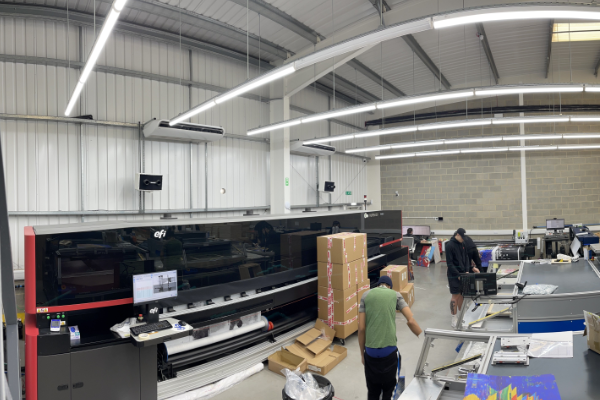
This results in canvases that have been printed on a fleet of Epson SC-S80600s, now supplemented by the arrival of an EFI Vutek G5. This enables the leap in productivity and capacity that the business needs. In the early months of lockdown volumes leapt 400% and the growth has not stopped. Parrot Print aims to print, cut and dispatch everything on the same day pushing cut off points for that day’s daily orders to 4pm in some instances. The Vutek is taking any strain away from this system and is able to delivery the consistent quality that is needed.
“We have followed the Amazon and the McDonald’s models,” Dahan says. “We try to eliminate as much human intervention as possible to cut out errors and also make sure that anyone only has four steps to take to do their job.
“This means that we are extremely efficient compared to the closest competing businesses out there. All orders are processed, printed and despatched on the same day. I cannot understand why some companies have a five day turnaround at best.
“And we take the concept of consistency from McDonald’s. In any of their outlets, the product is identical. It’s all about the consistency of manufacture.”
This is helped at Parrot by the very limited substrate range used which also makes scheduling easier, there being no need to build batches of jobs. Once printed, the barcode identifier on each job is used to drive the cutting table and to marry the canvas with a dispatch label at the packing station. This cuts out packing errors, says Dahan. It was not always the case. When the business started there was no automation and there could be scramble to match the image with the customer. “Then we asked ourselves, how can we save time, how can we automate more? And now whenever we get to the point where the task becomes difficult to do manually, we say ‘let’s automate it’,” he says.
The result is that even in the run up to Christmas, everything ran smoothly, even with addition of a night shift to help manage the volume of orders. Jobs were printed, trimmed, and packed in an unhurried way. Getting to this point took a long time and was complex he explains. Automation now is built in. “I have worked in chaos,” Dahan says, “and it doesn’t work. You end up with a very unmotivated workforce and the product suffers.”
The process starts with an order placed by a customer and an uploaded file. The customer payment and delivery details are logged or recalled for a repeat client and the order identified by a code. The file is sent to Parrot’s pixel optimisation engine. This is software that is unique to Parrot. It checks the pixel density which would normally limit the maximum output size based on incoming file size and output choice. Rivals have a density checker, but “ours has more complexity than that.” The aim is to avoid the disappointment Dahan had suffered in Australia. The software acts like a preflight, telling the customer the maximum output size that can be supported without loss of quality. With this the company offers a pixelation guarantee.
The optimisation takes place on a server that can handle 400 orders every 20 minutes, 1,200 and hour. Should the need for more capacity arise, further capacity can be added. The approach is highly scaleable.
The workflow includes Switch “as a wrapper” and a lot of custom scripting. “If I had started out coding, I would have been quite good at it,” Dahan says. “My brain works in a very logical fashion.”
It has also enabled the design and creation of a customer experience that aims at the ease of use of the leading retailers. The same customer experience designers that had been engaged by Nike and Apple, worked on the website. The intention is to give customers everything they need to place the order. This includes how to blogs, background on the process and information that anticipates questions that might make the customer hesitate over their purchase.
The website design involved A/B testing to find out which version customers preferred; it involved tracking journeys and it involved mystery shoppers to report back on their experience of buying through the website. “One of the questions we are always asked is ‘is my image good enough quality?’. We are also asked about the couriers we us. We want people to be able to go ahead with a purchase with confidence that there will be no surprises.”
The marketing aspect is equally important. Parrot Print will use social media, the press and Google Adwords as well as organic SEO to ensure that the word is spread as far as possible. It’s a deliberate multi-pronged approach. “If we stuck to one type of advertising, it simply wouldn’t work,” he explains.
And it does work. There are orders coming in from the US as well as from the UK and customers in the EU. The speed of turnaround is a key attraction, Parrot being able to beat local competitors to serve US customers. The timing is important, hitting the right pick up time each day to get to the airport and across the Atlantic. “We got lucky when we were looking for shipments to the US. The courier company had a new plane to fill so were keen on their pricing to get us on board. We will deliver to the US in two days, consequently many customers don’t realise the job is printed in the UK because it’s so quick.”
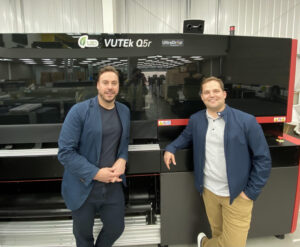
The global growth has been reflected in investment in what is the first Vutek Q5R press in Europe. The 7 tonne machine is on a different scale to the Epsons which have been the foundation of growth so far. “We have hammered them,” says Dahan, “and we’ve never had a serious issue with them until we reach end of life.
“In comparison the Vutek is huge and the speed and quality is just unbelievable, even on two-pass printing. There is simply no banding and it is as productive as 28 Epsons would be. It pays for itself simply by being here and offers us even more in terms of growth – we are not using it anywhere near its production capacity.”
It paves the way to expand Parrot’s product offering beyond canvas wall art. Dahan explains that new products are being readied for introduction in the coming weeks, but is understandably tight lipped about the details. He says: “For us the most important thing about any new product is how we can automate production and manufacture. We know this gives the customer a better product and better service.”
This too is following in the footsteps of Amazon. The online behemoth started with one product: books. Now there can be very little that it does not sell, once customers gained the confidence to do business with it. The same approach is working for Parrot Print. The number of returning customers is increasing. Growth has been on triple digits for the past five years, passing 500,000 canvases sold in recent weeks. Thanks to automation of everything that can be automated, a team of eight in production and six in the office can handle the growth. It has the space, it has the technology and it has the business plan.
All because a picture of Sydney harbour did not turn out as planned.