ISDN, the Integrated Services Digital Network, is coming to an end, bringing down the curtain on a technology that was a first step in the digital transformation of the printing industry.
ISDN allowed the digital transfer of files across standard telephone networks with modems at either end. Prior to ISDN there was satellite data transmission and dedicated digital lines to move files. But these were available only to those with deep pockets and enough traffic for it to make sense.
This meant newspapers, from repro houses and news desks, to printing sites, sent final pages each night and advertising during the day. It meant financial pages being sent across the Atlantic for simultaneous publication on the London Stock Exchange and on Wall Street. Everybody else used the Honda Interface, the motorcycle courier carrying films or a mag tape or cartridge from a repro house, publisher or typesetter to the printer.
When ISDN appeared in the UK in 1986 it promised to transform this process, the equivalent of a high speed fax machine which could extend deadlines and eliminate trips to the Red Star office to send films to printers on the last train north. Now, more than 30 years later, BT has announced it will cease to sell ISDN services in 2023 and will withdraw the service altogether two years later. By that time high speed fibre optic lines will carry voice as well as data and System X digital exchanges, The old electromechanical switching gear will be obsolete and the last vestiges removed.
At its peak, ISDN reached 25 million users worldwide with paired lines (ISDN2) or ISDN30 for users requiring greater capacity. Rather than point to point connections with dedicated lines, ISDN used the existing network, a dial up way of sending digital files at the dizzy speed of 64kb/sec, 128kb/sec for a pair.
Printers, as they have throughout the history of advances in technology, leapt on ISDN. Here was a way to wipe out distance between publishers and printers and repro houses. To prove this concept, one graphic arts magazine decamped to the far north of Scotland and sent the magazine’s pages to the printer in the south east. It was work from home without the need for a pandemic. The next issue of the magazine reverted to a more conventional production method.
This was still pre PDF days when desktop publishing was new and colour repro was in the hands of Crosfield Electronics, Hell, Dainippon Screen and Scitex. Hell and Crosfield had long experience in fax systems, using dedicated lines in the newspaper industry. Scitex, being a child of the Israeli aerospace sector, had satellite transmission technology, notably a laughingly described portable scanner called the Satlight. ISDN was a great opportunity to open the way to more remote printing. Within four or five years of BT introducing ISDN, the technology was ready for the mainstream printing industry.
One of the first implementations of this came at the Barcelona Olympics in 1992. These Games already scored a notable first with a digital printing network using the just introduced Xerox Docutech printer so that officials and journalists might print on demand a sheet of results from events at another stadium in the complex.
Crosfield Electronics agreed to set up two prepress studios in adjacent rooms, one for Toppan Printing, the other for Dainippon Printing, the two Japanese print giants that had committed to send digital images back to Japan. Photographers, all shooting on film, would queue to have their films processed and editors would then select the transparencies to use on publications back in Japan. Rather than send these back on planes, the wonderful new technology could deliver a faster and better service.
At around midnight on each day of the event, the prepress studios sprang into life. The Magnascan drum scanners analysed the chosen images and instead of driving an output device on site, the data generated was sent via newly installed Spanish ISDN lines, through the country, around the Mediterranean, through Asia to the destination in Japan. The two printers were only sending images which were not too demanding on the technology and it was deemed a success. Although not fully adopted immediately, by the time the next Games came around, ISDN was established as the means to send pages for print.
Where ISDN started to fall over was when full magazine or catalogue pages needed to be sent. The native files could be large, at least for those days. Scitex, for example, used a two file structure, one for the text elements of a page, the other for the contone colour elements. The files were large.
When Printing World moved to print at Pindars in Scarborough, the production director was convinced by the printers that this was the future and should be used to keep the magazine as up to the minute as possible. It was not a success. Transmission times were painfully long and very far from seamless as connections needed to be established at either end. ISDN became an abbreviation for It Still Does Nothing.
Printing World quickly reverted to sending films from the Red Star office at Kings Cross to York, where a courier then picked up the package.
ISDN was not only for magazines and catalogues. The technology could remove the uncertainty of road or rail transport in other sectors. Springfield, in the days before it became one of the country’s leading label printers, was a packaging repro house. It believed that the digital technology held promise and put it to the test, sending the artwork for a Teenage Mutant Ninja Turtles promotional pack to the printer in North Wales. Transmission time from Hull was more than eight hours, twice the time to put the films on a motorbike from one side of the country to the other.
Managing director Matt Dass reflects now that digital networks have again been put under pressure, this time by work from home and sometimes flaky internet connections.
The requirement for digital file transfer was established, getting a further kick with the advent of computer to plate technology in the middle of the decade. At the same time, PDF was becoming established as a file format for printing, a more robust replacement for PostScript which had already driven a stake through CT/LW and other native files. Before PDF could take real hold, publishers and printers tried a range of workarounds. There was the OPC workflow, where the printer held the high resolution file and provided the publisher with a low resolution version for page make up. When the publisher sent the page for printing, the high resolution version was substituted on the fly.
This reduced the data needing to be sent down the line. Compression routines, like those devised by Highwater, allowed the publisher to retain possession of its images, while again cutting down the data traffic. RealTime Image, an Israeli company, created a means of breaking the file into different versions. At the end receiving the file for proofing and online approval, a low resolution version loads quickly while in the background more data is streamed into place allowing more detailed examination of the image. Others developed similar technology including 4-Sight, a UK company which quickly became a leader in ISDN networking.
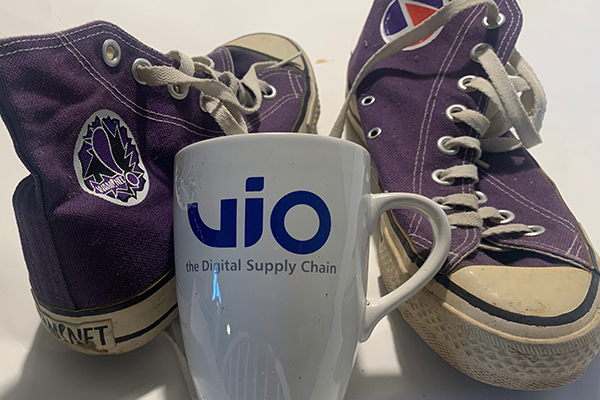
All were over shadowed, however, by Vio and WamNet, two file transfer and management systems which separated the upload and download steps from local servers with very powerful, high capacity, high speed links owned by the data transfer business. Today this is the Cloud. Vio was a UK company staffed by former Crosfield people and headed by former Kodak executive Mike Simmons, wearing bright orange polo shirts. Wam!Net was the brash US company, distributing purple sneakers and holding extravagant Wam!Bash parties at international events. The companies came head to head at Ipex 98 and then at Drupa 2000, fighting for attention and market share when all at once the issue of file transfer speeds faded away. The more compact PDF format was corralled by Ghent Workshop Group to behave as the printing industry needed through PDF/X and its variants.
The two file transfer giants tried to retain customers by offering additional features, but the appeal of a low cost transfer, using the file transfer protocol and more recently, services like WeTransfer, have won out. High speed broadband, and now fibre, have buried the need for specialist file transfer services. This is why BT is burying ISDN. Few will mourn its passing.