
Brexit is offering a mixed blessing for printers according to a survey carried out by the BPIF. While the full results of the research are not published for a few weeks yet, chief executive Charles Jarrold gave delegates to the Print Power seminar in London last week a sneak preview.
The lower exchange rate provides an opportunity to sell more into Europe, though this advantage is outweighed by the negative factors. “a much lower number of respondents see the impact as positive,” said Jarrold. “The big unknown is what happens in terms of access to the EU market, while access to a source of labour is also a concern.”
There will be opportunities from any uplift in the economy, from the presumed wider export opportunities and from lower interest, but the overall tone appears to be continuing uncertainty.
An earlier snapshot had printers suffering in the immediate aftermath of the vote, but demand for print had since returned to its pre-referendum levels. The restructuring of the industry away from large volume products in magazines, catalogues and newspapers continues, but print is more than holding its own.
Jarrold pointed to the influential report on the state of communication and the internet by Mary Meeker which found that print channels continue to take a disproportionate amount of the spend, while mobile is very much under represented. And he pointed to comments from Martin Sorrell to the effect that “print drives engagement more effectively than people give it credit for”. This is undermined slightly by figures from the WPP agency that Sorrell fronts showing an increase in spending on digital advertising.
However, David Gold, head of public affairs at Royal Mail, supported the arguments that print is vital, at least in some circumstances. He heads the Keep Me Posted campaign, a group which puts pressure on utilities and financial institutions to provide printed statements and reports should consumers prefer print to digital.
While this has the greatest impact on the elderly who are in many instances digitally disenfranchised and may never have used the internet, it also affects the young who should receive printed communications to ease their understanding of financial matters and avoid accumulating excessive debt.
The day attracted 200 delegates to Stationers’ Hall, the most the seminar had attracted in its four years. There was less concern for the continuing survival of print than in previous years, something underlined by a line up of speakers that ranged from neuroscientist Baroness Susan Greenfield, to designer Wayne Hemingway and ad guru Dave Trott, to Cedar Communications Kim Willis and DMA managing director Rachel Aldighieri.
She stressed the importance of print working hand in hand with digital. “Every marketing campaign should have data at its heart and should generate data,” she said. And as Tiffany Darke, founder and director of Method, had earlier described, print carries with it authority, it conveys luxury and delivers engagement.
Though the baroness, explaining the different impacts that screen based interaction has compared to reading off paper have on the brain, delivered the most flattering conclusion, “Print isn’t just print – it’s much deeper than that. It enables you to think.”
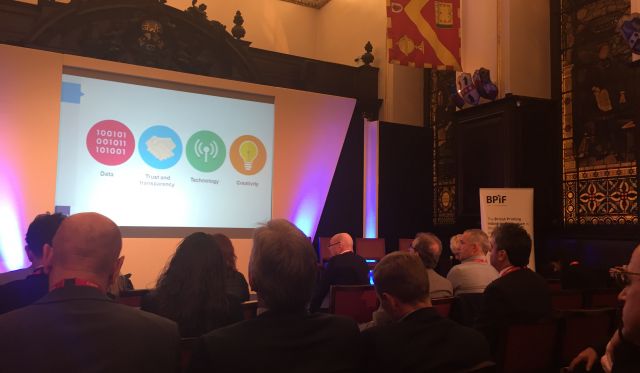
Stationers’ Hall was full for the Print Power seminar last week as a stream of speakers from a wide range of sectors, confirmed that the printed page has a unique position in how it affects the human brain, making print more powerful than digital media.