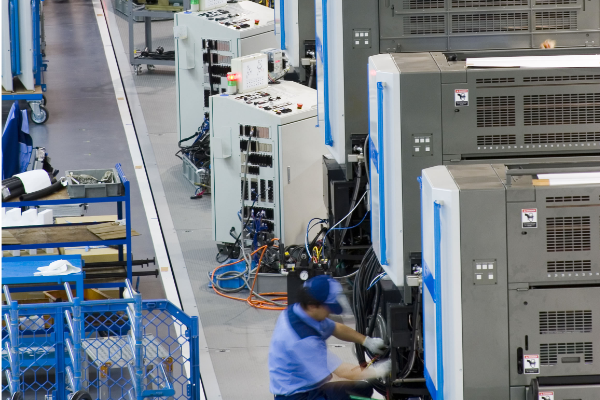
Japanese press manufacturer Komori plans to develop new products, combining expertise from the press manufacturer and its new subsidiary MBO. “MBO’s products will help provide customers with even more robust, seamless printing production systems that include post press processing” Komori says in the 2020-21 annual report.
This will come with integration into the KP Connect production and other IoT cloud based solutions that Komori is developing. “Komori is also looking to develop new solutions through the combination of MBO Group’s technologies and Komori’s Digital Printing Systems, offset printing presses and other key products”. The report points to MBO’s experience with robot systems to reduce the labour element in production, as well as thin paper expertise in the H+H division.
These activities do not yet show up in the section explaining the focus of the company’s R&D investments. These are broken down into three areas: offset presses, digital print around the NP40 and printed electronics. This uses a high precision flatbed gravure system which can print with greater accuracy than the screen print method that is widely used.
Komori has teamed up with a key technology provider to the market to put its approach through its paces, printing a 300mm silicon wafer with millions of electrodes to an accuracy of 5 microns and with only 30 defects per 10 million solder points. The testing phase is now leading to more demanding projects and orders for these gravure presses. Consequently, the printed electronics division has experienced a sales growth in the last year.
The emphasis in litho printing is on automation and improved print speed for its Lithrone range. The latest Advance models enjoy a redesigned air flow system to improve sheet handling at speed, an improved Komorimatic dampening system for greater consistency and predictability and changes to the KP-Connect press management system to make the press easier to operate, with less intervention at makeready and during the run.
The third area of R&D focus is the Impremia NS40 digital press, the press that is based on the Landa nanographic printing technology. As well as working through its own KP-Connect front end technology, Komori is fitting its own quality monitoring system to check for defects, including fit and nozzle issues. This is the PQA D, built around technology used on its currency presses where each sheet has to be checked for defects. This will result in an automated quality adjustment technology, operating on a B1 sheet at 6,500sph.
Komori is starting to see a recovery in orders from North America and China, but repeated outbreaks of Covid-19 has meant that orders from European customers have fallen as printers either cancelled or postponed orders, according to the annual report.
This has also affected orders in the rest of Asia, which has spilled over to its security presses division where installations were delayed.
The result was an operating loss of ¥2.3 billion on sales of ¥71.8 billion. This was an improvement on the previous year when the operating loss was ¥3.4 billion on sales of ¥77.6 billion, and amounts to a 7.5% drop in sales value. Along with the improvements at the operating level, thanks to savings on administration (partly due to a reduction in travel expenses), the company managed to increase its total assets to ¥144.4 billion compared to ¥135.7 billion.