
Heidelberg is introducing a hands off press makeready as part of a concept it is calling Press to Stop. The idea is that once an operator loads plates reading tor mounting the press will manage itself through a loading, washing and start up sequence that includes delivery a first in fit and in colour sheet for the minder to pass.
This is enabled on 2016 specification XL106 presses with the full spectrum of automation including Prinect Press Center XL and Inpress Control. This means that the Intellistart 2 software cannot be supplied as a retrofit to upgrade existing presses. As yet the suite of applications for autonomous press control is only available on XL106 machines. VLF machines may have components of the system, though the road map points to the XL75 being the next machine to benefit in this way. Finally the CX B1 format presses will follow.
At Drupa the technology is put through its paces on a three-section job, where sheets are printed and a full section change, including blanket wash, takes place twice in less than eight minutes. The operator’s role is reduced to loading plates and removing the spent aluminium. In effect this turns the press minder’s role into an assistant’s job and eliminates the need for two-man operation.
It is s giant step towards the lights out goal that Heidelberg CEO Gerold Linzbach has described. There is no means of changeover of pallets at either end of the press, nor of bringing plates fro the next job into position.
On the Primefire 106 B1 inkjet press, this is not necessary as the automated workflow will prepare the next job and no plates are necessary. This is the highlight of the stand, with an English language presentation taking place at 3pm each day. Large flat screen displays held in robotic arms interact with a pair of Eurovision style presenters and position the inkjet press as a solution to the rapidly increasing volume of short runs jobs that have to be processed. In the show configuration the press has a pre coating unit, twin post press coaters and a delivery that includes a rejection chute for sheets that fail to reach the required quality.
The press is on schedule for delivery at the end of this year to beta customers and for full commercial production in 2017. Heidelberg is happy to take orders at Drupa and will be discussing the financial aspects of operation with those showing a keen interest behind closed doors. The model is based on capital cost of the press and a volume price for the ink.
The Drupa specification calls for a productions speed starting at 2,000sph in quality mode, potentially rising to 5,000sph once the first machines are in the field. The speed is not a concern as Heidelberg believes the press will run at this rate around the clock. Machines with high rated print speeds will have to stop for maintenance, hitting overall production volumes, Heidelberg suggests.
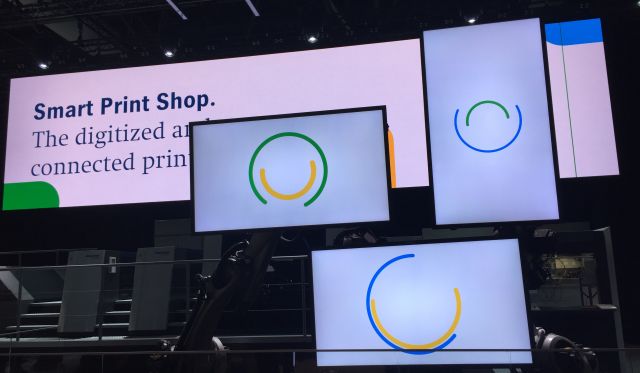
Three flat panel screens on robotic arms are used to entertain visitors watching the demonstration of the Primefire 106 inkjet press. These also drive home the point that printers must cope with an increasing number of jobs per day and per shift, forcing them to look at systems integration and automation to ensure efficiency of production.