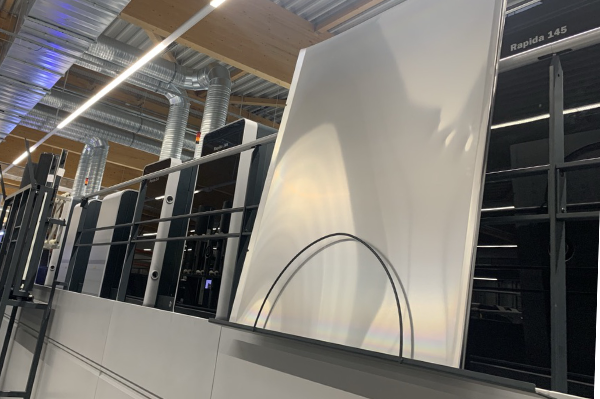
The unveiling of the Koenig & Bauer Durst Varijet 106 was not the only debut in Dresden last week. The litho press manufacturer also announced the latest version of the very large format Rapida 145 and Rapida 164 presses, taking printing speed to 18,000sph on the Rapida 145 and to 17,000sph on the Rapida 164. A seven-colour version of the Rapida 145, with twin coaters, is installed in the packaging customer experience centre alongside a Rapida 106X, with space for the Varijet 106 to complete the line up.
The new large format presses gain the sleek look that was first seen, online only, on the Rapida 106X when launched last year.
The new machines introduce fast makeready and automation features from the B1 format presses. These include the sideway free Drivetronic SIS infeed, simultaneous plate change, pre registration, plate identification, simultaneous coating from change and rapid anilox roller change over. The aim is to help packaging printers cope with decreasing run lengths and shorter delivery times. Like the mid format machines, a range of quality inspection and closed loop control is also available.
The press will cope with a maximum thickness of 1.6mm board, with Koenig & Bauer showing the machine printing a sheet of different beer mat designs to underline this feature. The press will also print corrugated boards to this sort of thickness.
The Rapida 164 is now the largest press in the portfolio following the sale of the last Rapida 205 last year. That format is now better served by large format inkjet than offset litho.
The packaging sector is one of three growth areas that Koenig & Bauer is targeting its energies on in sheetfed offset. The others are web to print in commercial printing as well as wet labels and in mould labels. Each will have a separate customer showroom on the factory site at Radebuel, near Dresden.
“We are developing machines for each of these segments,” says head of technology and product management Dirk Winkles. “Each of the segments influences the other. For example, when web to print started 20 years ago, it was about high volume and low cost printing, achieved by standardising every aspect of production. Now the carton and label printing industry are benefiting from the technology required by web to print customers. And now some web to print customers are starting to offer some light packaging.”
The packaging customer experience centre also includes a standard die cutting platen, an Allpro folder gluer line and the new 15,000sph CutPro 106 rotary die cutter. This has a feed end from a Rapida 106 leading to four separate units, where instead of printing the sheet can be embossed, creased, die cut and have the inner waste stripped out, leaving a sheet of blanks held together by the framing outside. When 50mm of sheets is gathered in the delivery the stack is pushed out and positioned beneath adjustable pins to remove the last water and leave neatly stacked blanks ready for gluing and packaging.