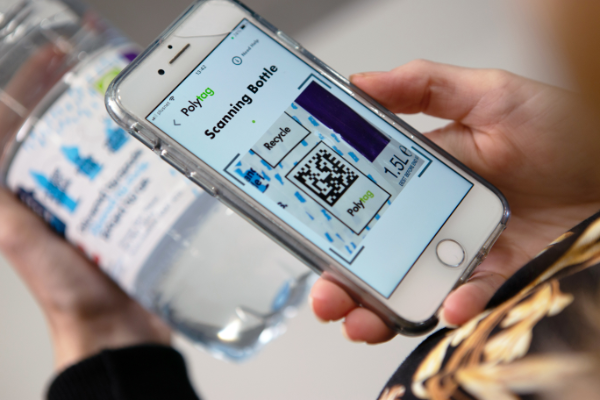
A deposit return scheme developed by Polytag has passed its pilot project in Wales with flying colours. The kerbside collection scheme uses a unique printed code on a conventional printed label that a householder scans with an app before adding the plastic container to the recycling scheme. This triggers a micro payment to the consumer, equivalent to the additional payment made at the point of purchase. Such schemes will be essential to comply with producer responsibility provisions under single-use plastic regulations.
The pilot project was the result of collaboration between Polytag, the Welsh government, Conwy Council, Ecosurety and Wrap Cymru. More than 300 households were supplied with six bottles of mineral water with labels printed with a unique 12×12 code, which they were asked to scan when putting the bottles out for recycling. More than nine in ten scanned four bottles and 73% scanned all six.
The bottles had the code applied at the filling line using a thermal inkjet head over a label printed in a conventional way, though with space for the additional code. The Polytag technology assigned a unique identifier to each bottle, which is scanned by the householder as well as by visual recognition technology at the waste handling plant.
The system fits an existing process, with the public becoming accustomed to scanning QR and similar codes during the pandemic. This is reckoned to be smoother than returning packaging to the store for collection and it will help brands identify the level of plastic tax that will be payable.
“We can give brand owners a unique coding structure that uses digital print on part of the label and we can identify each container,” says Phil Sutton, founder of Polytag.
The technology can identify up to 30 billion items. “We designed the system so that printers with litho or flexo can use it because digital is not quite there at the moment for volume and cost reasons. The variable element does not have to be the whole label and adding it is a simple retro fit with a thermal inkjet head to print a 5mm-high code.”
The Polytag system can control up to 30 printheads. There is no impact on line speeds. It is, says Sutton, a light touch approach to meeting producer pays responsibility and, as a £30,000 investment, should prove justifiable. “Printers can see the benefits of our system and how flexible it is and what else this can deliver, including promotional messaging to consumers,” he says.
The pilot scheme received the support of the householders involved, as underlined by in depth interviews with 10% of those involved.
CEO of Polytag Alice Rackley says: “As we move closer to implementing a nationwide DRS, it is vital that brands, retailers, government and technology suppliers work together to find the most convenient way for consumers to recycle containers. We firmly believe that kerbside based collections are the most effective way to achieve real change while delivering significant benefits to brands.”
The initial target for a deposit return scheme is the estimated 14 billion plastic drinks bottles, 9 billion cans and 5 billion glass bottles that end up in the waste stream each year, much of which is not recycled.