
Web to print has never been tried on the scale that Newcastle printer Imprint is considering. There are printers that handle more jobs, printers that take more revenue than Imprint intends, but no other printer has applied web to print to large format display printing as Imprint is considering.
There are good reasons for this. If nothing else the file sizes for the sorts of display print produced at Imprint are enormous. And nobody would sensibly develop a specialist display print application before web to print for commercial printing. But Imprint wants to break new ground with variable data printing: it has to develop its own solution.
The company operates with three Inca Onset S20s, the largest concentration of this press type in the country, an Inca Spyder and most recently a Xerox iGen4 in a new factory ten minutes from the centre of the city. The company moved in only in September, installing the last of the Onsets in January. There is a separate screen printing factory with a four-colour Thieme and two single-colour machines across the city.
“We will never get rid of screen, because there are things that you do only with screen printing,” says group production director Paul Newton, explaining that screen is unbeatable for high impact fluorescents, for metallics and for some spot colours. Four-colour printing is, however, reserved for the digital machines, these days in a spacious 21st century plant. It is on a development that is more science park than industrial estate, finished to a high specification throughout and designed for the next phase in the company’s development. It paves the way for the company to grow from around £7 million a year to £10 million.
Imprint started 23 years ago as a screen printer operating hand benches, added litho printing and acquired a customer base from retail and brands looking for point of sale and display print. Litho was dropped as it was easier to buy this in than to keep investing and the business stepped away from any temptation to invest in ultra large format KBA or Manroland presses. Instead Imprint has moved in the other direction, building on its decision to invest in large format inkjet printing.
In 2001 the company had become only the third to buy an Inca Eagle 44. At the time sales were just £1.4 million so a £400,000 spend was more than significant, especially as inkjet had still to prove it could handle the demands of display print customers. That was in 2001.
“It got us out of the rat race to some degree,” says group development director Dave Bullivant. “You can’t survive as a commercial printer, you have to offer something different.” In 2007 it acquired Perfect Screen Print, doubling the sales of the business at a stroke, now poised for the next leap forwards. The relationship with Inca and with distributor Fujifilm Sericol has endured through new generations of press. “We have noticed a big improvement in the quality of digital printing,” he continues. At one point the company had three Eagles and two Spyders, sweeping them aside to start the new plant with a new generation of technology.
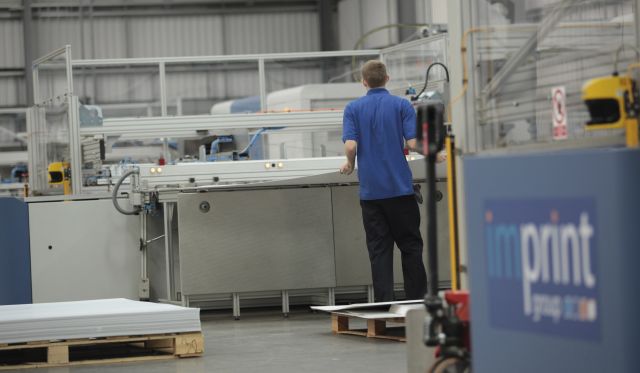
The three Onsets are spread along the length of the new factory which looks as clean as when the company moved in in September last year. All are profiled to match Fogra 39L proofs, allowing large jobs to be spread across the three presses if needed.
The move brought together 60 of the company’s 72 staff together under one roof for the first time and has given the management team the chance to set a new culture. Productivity has improved through the efficiencies of having everything in one location. “Many of the staff had never worked together before and many have worked in factories which simply did not have windows,” Bullivant says.
Newton adds: “It has been a tough year. We started with a shell of a building – no lights, no heating. We had to decide where to position power sockets – everything. And we made the move without any customers realising what was going on. It has been a big step change.”
There is plentiful natural light in the Breeam specified building, it is energy efficient and rainwater is harvested. The environment, not surprisingly given its customer base of retailers, is a priority that Imprint pays more than lip service towards. It has taken on graduates on projects looking at how to cut its carbon impact still further. The new factory has allowed it to take another step greenwards.
Inside the company has specified high lux lamps to ensure that light is even throughout the plant and that there are no shadows created. Planning and executing the move took a year of working out, calculating where power points should be placed, how materials will flow from one end of the factory and what sort of office space might be needed. Nevertheless the move went to the wire. “We finally received the keys of the finished plant on the Monday with the first press arriving on Wednesday,” says Bullivant.
Other than keeping details of its move quiet, he says that the business is very open with its clients and suppliers, fostering deeper relationships that when it comes to selling variable data print will open doors inside the marketing departments that have to buy in to the potential of VDP.
“The future for us is all about variable data It’s about web to print working, it’s about personalisation,” says Bullivant. “Once we talk VDP we are talking to the marketing departments rather than just print buyers.”
In one application of the technology Imprint expects customers to create artwork on line, choosing the campaign images and amending templates to suit a specific store and printed on the Onset digital presses.
“We aim to make the customer’s job easier, writing bespoke customers for retail customers so that all their promotional activities can be managed online,” says Newton. This includes being able to calculate costs for large format print, something else that is not widely available in off the shelf MIS. “Existing MIS are great but we would end up having to adapt it to suit our needs, so we decided we needed something that would meet the needs of our own business,” says Bullivant.
The workflow is more usual, Imprint using Esko Artwork’s Odystar PDF workflow to feed the Rips. Once printed, die cutting is courtesy of a mammoth Crossland platen and fulfillment wrapping takes place in the centre of the factory.
A recent addition has been an Esko Artwork Kongsberg digital cutting table allowing Imprint to take on 3D displays. It has added expertise in this area understanding that this is equally essential to success in providing the free standing display units that are a key feature of point of sale material. “We produced this for an American customer who told us what we did was ‘the best executed campaign he had ever had from a vendor in the UK’,” says Newton.
The latest investment has been the first extended format Xerox iGen4 in the UK. This will produce smaller format point of sale work, variable data print and will reduce dependence on local litho printers, particularly for fast turnaround jobs. It has its own area of the factory, away from the Onsets. “Now we can print those fast turnaround jobs ourselves rather than having to find a very friendly supplier when same day delivery is required and that can be difficult,” says Newton.
The IT system tracks job progress which is displayed on a huge flat panel monitor that everyone can see. Operators watch live information including productivity levels, which machine and crew is proving most efficient in terms of both square metres images and beds filled over the shift, the day or week and so on.
The idea is to prompt a degree of competition between the press crews and raise awareness about the impact on business performance. Press operators are trained in how to run the presses to achieve the best quality and maintain highest reliability. Some have been sent on Inca’s advanced operator training to allow greater amounts of maintenance to be handled in house.
Training is a key element to how Imprint operates. Staff are able to work across different machines and departments if demand dictates. “And it’s important to have multi-tasking people. You can’t tell someone that ‘this is the only job you will ever do’,” Bullivant adds.
The directors have been known to get down on the shop floor and to help pack during the busiest periods. But management does not get to operate the machines despite succumbing to ‘printers disease’. Bullivant says: “We are very hands on and we love machines as many printers do. But we have to think beyond that.”
There is a day each week set aside for what the management calls “working on the business”, a step away from the dealing with the immediate production issues and forcing an agenda of dealing with deeper issues, looking ahead and thinking strategically. This is something that sets Imprint apart from those that are constantly engaged in the rat race for work. Bullivant says it, but all the directors would agree: “It’s the people that have invested during the recession that are going to be best placed coming out.”
In one application of the technology Imprint expects customers to create artwork on line, choosing the campaign images and amending templates to suit a specific store and printed on the Onset digital presses.