
It is no longer unusual for a print company to move from two presses to one. It saves money and exploits the additional productivity possible with newer technology.
Admittedly is it is more unusual for a printer to move from two ten-unit perfecting machines to a single six-colour plus coater press. And it is unheard for that company to also increase sales by 40% following the installation.
Elle Media is that printer and it has not suddenly discovered a rich vein of high margin products it can print. Instead it has pushed an agenda built around automation to increase productivity.
The printing press is no longer at the heart of the business as a machine for printing; it is an industrial tool, explains managing director James Cuthbert . This places the press as part of a continuous flow of data from incoming order to outgoing invoice and job delivery.
The press becomes important not only for what it can do but for what it can communicate about what it is doing and what it will be doing next.
The press is a Heidelberg Speedmaster XL106, a replacement for a 12-colour SM102 and 12-colour B2 Komori Lithrone. The long perfecting B1 press was installed only five years ago when the company moved to larger premises in Basildon across from its old plant.
James Cuthbert was then being groomed to take over from Bruce Cuthbert who had grown the business as FM Print. He is still involved, but very much on a part time basis and the new era is down to the drive of James .
“We ran the B1 machine for three years before we started looking for a new press to run alongside the B2 machine,” he says. “When you start to do this, you realise how much has changed since 2006 when that press was built.
“We looked at KBA, Komori and so on and were thinking about ordering a ten-colour Speedmaster CX or CD.
“Heidelberg was keen to talk about XL technology: clearly this is what they wanted to sell. I went to ESP Colour and met Anthony Thirlby: it was an eye opener, a real glimpse into the future.”
At the time ESP was setting the standard for automation and productivity and was the star customer for Heidelberg worldwide in demonstrating the impact of manufacturing practices on a printing business.
Makeready times had been shaved by minutes and seconds in the search for the perfect performance; consumables chosen for their ability to cope with the demands of accelerating to full press speed, running for a short while and repeating the process to print 80 million impressions a year. Variables were reduced to the bare minimum. Like a Formula 1 car, it was a single-minded pursuit.
“From that visit I learned that the machine becomes secondary. The important thing was what the machine would allow you to do. As soon as I came out I emailed Bruce saying that this was what we were going to do,” he says.
The Speedmaster XL106 was duly ordered and installed in February two years ago. As Cuthbert says, the technology had changed completely since the 2006 generation machine. There was no longer any need to be concerned about print quality thanks to the consistency delivered by Inpress Control, since upgraded to Inpress Control 2.
Cuthbert continues: “The quality of print from the XL106 is a given and the consistency is excellent. We used to use Bodoni as an off press measurement system. It was excellent, but we were constantly stopping or slowing the press to feed in the adjustments and accelerating again, which has to affect consistency.”
The new machine provides a stable platform, which, as ESP Colour has proved, is essential for consistency and for reducing makeready. The requirement then shifts to delivering data to the press and automating workflows.
Elle Media had a Screen Trueflow production workflow and MIS combining the Haysbrook Associates PDQ estimating system and its MIS. Neither would be suitable in the new highly automated world, the MIS because it simply was not PDF compatible.
Nor is BigIceBox, the application that Elle has used to handle imposition for greetings cards. It is being replaced by something that will be installed after Drupa that will deliver cutting sequence data to the new Polar 137N guillotine that has become a seamless part of the workflow.
ESP Colour used a combination of Tharstern MIS, Kodak Prinergy workflow and Heidelberg Prinect to control its presses and flow of jobs around the factory. Elle has not tried to replicate this. It is using Heidelberg Prinect as the workflow with Tharstern as the MIS.
“The Heidelberg MIS was not as advanced as it should have been,” says Cuthbert. However, as Tharstern has completed a number of installations with Prinect there was no concern for Elle. John Murphy who was instrumental in the deal, has since moved from Heidelberg UK to join Tharstern to cement the arrangement.
The switch to the new workflow came in stages, Prinect arriving at the end of 2014 and Tharstern in the August. The MIS supplier had to write new modules to cope with some of Elle’s special requirements. This revolves around greetings cards which are batched up on a plate for production efficiency but which need to be costed as separate jobs.
The new module meant a calculation for each card based on its share of the sheet and therefore of the makeready and running costs. Ahead of imposition and after guillotining the card is a separate job with easier to manage costs attributed to it.
Elle is both a printer and publisher of Christmas cards, producing millions each year for a host of large and smaller charities as well as corporate and branded cards. There is a room on the upper floor of the factory where hundreds of cards are displayed in racks and a seasonal tree twinkles constantly.
“Every day is Christmas for us,” says Cuthbert. These account for 20% of revenue, but somewhat less in terms of press time, perhaps 5% he says. It amounts to four to six weeks of production time a year when production is easy to optimise as the same materials are constantly on press and all that is needed is to switch one set of plates for another. “It’s essentially section work,” says Cuthbert.
Apart from working out a way to deliver a JDF compatible file for the two guillotines, this aspect of the business is straightforward to automate. Currently the company works with templates that the artwork is fitted to and which can be called up at the guillotine.
The optimum way of fitting the cards to the templates is part of the MIS module created by Tharstern. Any adjustments to the template can be saved back to the system for later use, but it is not a fully automated interaction.
Compare this to the way that production is organised earlier in the workflow. Artwork for a new job is uploaded via email to Elle Media via a Citrix server. This removes the attachment and flows it to the Prinect workflow which generates a proof to be sent back to the customer for approval.
The sign off is handled digitally and the job opened in the workflow, a hot folder taking the digital file through the Prinect process stages and job details, numbers, delivery date and location for example, within the MIS. The customer service reps work with the Tharstern and cannot reach the Prinect although what they are seeing is the result of processing in the Heidelberg arm of the workflow.
The job has moved from artwork submission, into generating the digital job bag, into prepress through imposition, colour control to apply the screening required and appropriate levels of UCR, through the Rip and platesetter without intervention.
“We can come in on a Monday morning to find that jobs have been approved over the weekend and there are plates waiting for us,” says Cuthbert. “The approvals process is automated because nobody wants to pay for amends. We are 90% of the way to Utopia.”
Again he points out that automation of a workflow comprising standard sections demanding the same paper is not particularly challenging. Elle Media is not that sort of business. As well as greetings cards it can be printing magazines, awards catalogues, fine art catalogues and take away menus for the local Chinese restaurant.
All are handled to the same ISO 12647-2 standard through the same workflow, regardless of the types of paper that may be used.
The final step will be in automating the handling of a mixed media job, say a catalogue that uses an uncoated stock for the cover with coated paper text section.
Once the plates are imaged, a half-size proof is generated for the press operators just as a visual check. Each job will also have its own barcode to identify the job and section. With the potential for multiple jobs on a sheet this is necessary as to apply the PDF naming convention would result in an identifier too long to be helpful.
The barcode, in contrast, can be scanned to pull all details to the piece of equipment, including shortly the cutting sequence on the new guillotine.
The MIS is also used to batch jobs with one crucial characteristic. This is not the substrate it is printed on, the obvious decision. This is because the press will adjust automatically for different types and weights of paper, at least within normal working parameters. Instead scheduling is determined by the coating needed. It can take ten minutes to change a coating blanket, Cuthbert points out, the longest task in a makeready.
A makeready with full wash up will take 3 minutes 40 seconds. It is set in the press and the staff follow. Likewise says Cuthbert: “We used to allow five minutes for a pallet change because we didn’t know how long it should take. Now it’s 1’40” because that’s what the machine allows.”
As the technology began to be implemented, it was quickly apparent that plate production would become a bottleneck. Investment to upgrade that followed. It has reached the point that each CSR is now coping with 346% more jobs than previously. It is not that people are working in a sweat shop, it is that the technology enables the productivity gains to be made.
And everything is measured and analysed for potential improvement. Cuthbert admits that an outlook with a dash of OCD helps. “When we have Tharstern managing director Keith McMurtrie, John Murphy and me in a room, it’s like three geeks getting together,” he says.
The figures, however, show that this is working. “We have achieved a 40% revenue growth in 18 months with no extra staff,” says Cuthbert. There are Powerscreens around the plant to show jobs that are in progress and which are due immediately, behind schedule or coming next.
On noticeboards there are charts to show improvement in operational effectiveness. In September last year, both finishing and press were running at around 50% of the time. Now the press is in operation 75% of the time and finishing working 80% of the time.
“We believe we can be running 90% of the time,” he says. This amounts to an extra five or six hours sellable time a week, effectively an extra shift of work to amortise the cost of the technology against and allowing Cuthbert to survive compared to those with a similar cost base but unable to sustain this level of performance.
“We recently produced 340 109 saleable sheets in 24 hours,” Cuthbert adds, apologising for not knowing how many makereadies this involved.
The figures are not about OEE in the strict sense, people are measured against what they can control, not the effects of mistakes or decisions passed down the line. The company has identified a range of papers that it knows will perform on press. These are not the cheapest papers to buy, but substrates that will run at the 18,000sph the press can run at. And it does. “If it does not run at this speed there has to be a good reason,” he says. “Running a spot colour is not a justifiable reason.”
The success of the approach depends also on focusing staff to extract the extra performance per head. There was plenty of preparation, explaining that processes would change and that staff would need to change as a result.
Cuthbert says the response from staff went through three stages. “Everyone thought I was mad,” he says. “You can’t push people so the stick approach will not work. You have to get buy in. They have to believe. We are lucky to have the team we have here.”
First the reaction was that that was being asked of them would be impossible; secondly came a stage where people found it stressful and now finally, there is an air of calm about the place.
People know the system works and they trust it. They know what they have to do and that they will not suffer for someone else’s poor decision. If a customer insists on a paper that does not run at full speed, the operator is judged not against this but against a theoretical virtual press set to run lamely in software only.
There are production meetings involving production director, managing director, team leader and a member of the production staff. The decisions from these meetings are posted on a spreadsheet so that everyone can see what is happening.
There has been a big impact on pay. As overtime is being eliminated, staff are instead rewarded for hitting production targets. Tier 1 success earns a 10% bonus and tier 2 results in 15% extra. It is a clear incentive and delivers more in their take home for fewer hours than overtime and importantly if they are winning in terms of wages, the company is winning in terms of work being produced.
It amounts to 12 weeks’ additional production a year, Cuthbert reckons. The system is very much geared to taking away the changes of introducing mistakes. Getting it right first time is essential, everything crumbles if there are late corrections. “If the right paper is not ready at the right time, productivity will drop and we return to chaos.”
That is not going to happen. Nor is Cuthbert concerned about being dependent on one machine. There is an e-call button on the press console which alerts a Heidelberg engineer. Most result in a fix to keep the machine running after 15 minutes delay.
“Nothing has really stopped production,” he says. “We had a 212pp A4 catalogue one night recently. It was scheduled for eight hours on press, but it was off after six hours. If we have a problem we can catch up.” Then, as the business operates round the clock for five days a week, there are weekends available if absolutely necessary.
Elle Media’s success is creating widespread interest among Heidelberg customers beyond the UK. Online print business Lasertryck from Denmark has been to Essex to see how it is done and the lessons that can be applied to what is already an efficient business.
In return the decision to invest in the Polar 137 and the full complement of handling equipment was a suggestion from the Danish company, one that Cuthbert is happy to acknowledge in the continuing pursuit of efficiency and productivity.
“Not so long ago there were jobs we had that had 60 hours of press time. Now a job has to be back with a client in the same time,” he says. Automation is the path for Elle Media to survive as a business.
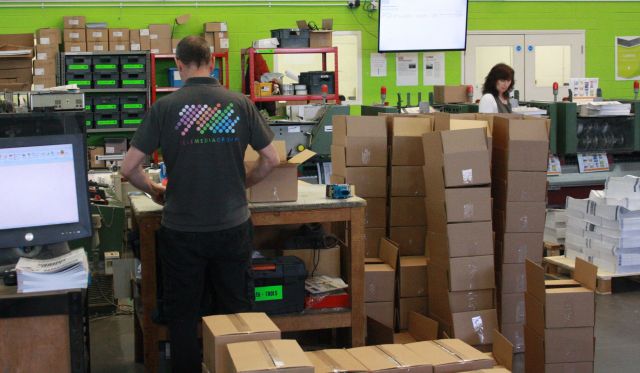
Elle Media has implemented a bonus system for its staff to ensure buy in for the focus on end to end automation. There are also reports of actions to be taken and the inevitable graphs to show improvements in performance.
“The printing press is no longer at the heart of the business as a machine for printing; it is an industrial tool,” says Elle Media managing director James Cuthbert