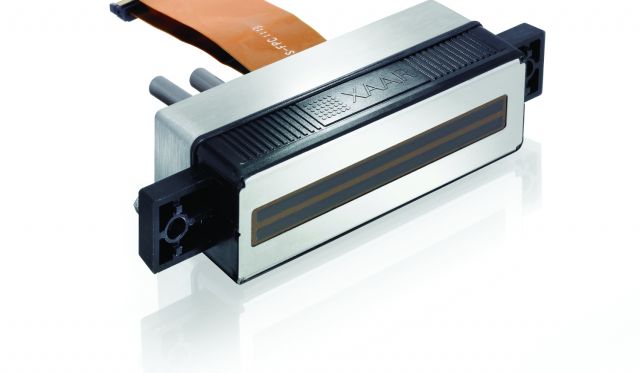
Printers are unlikely to notice any speed or quality improvements delivered from the new Xaar 1002 printhead, the replacement for the venerable (in inkjet technology terms) 1001 head.
The 1001 piezo print head introduced the concept of through flow and constantly moving fluid when launched in 2007. This opened the way to print with more troublesome inks, including white, which led to its rapid adoption by label press manufacturers and especially by those building machines for digitally printing ceramics. Xaar has 75% of this market says sales and marketing director Richard Barham, while 40% of the market has switched to digital printing.
While this market sector will continue to grow, the focus is switching now to labels and to wider format packaging, applications that the new head makes more accessible. Andy Cook, managing director of FFEI, has worked with the 1001 head since it first became available and it is the print head used in the Graphium label press which will be shown at Ipex. He says: “Customers will not see any difference in terms of print quality, but Xaar has fixed a lot of stuff at head level that we as integrators have had to sort out in terms of calibration and so on in the high quality single pass UV print area.”
For Xaar the development will keep the company ahead of competition which can also offer through flow systems and therefore the ability to print with inks containing pigments which settle out of the carrier fluid. “None of the competitors has yet achieved the same volume and reliability,” says Barham. “This makes it hard to replace a print head that has been as successful as the1001.”
It also means that XaarS been careful to make that process as easy as possible: the new head has the same dimensions and fittings as the 1001, becoming a drop in replacement. 1001 and 1002 heads can operate on the same machine if required. The key advantages of the new head include improvements in droplet placement accuracy (the size remains the same at 6 or 12 pico litres depending on the version of the head chosen); in the ability to link heads to create wider arrays; and in the data that can be collected about the performance of each printhead.
This paves the way for developers to build wider arrays confident that colour will be consistent and with less software to manage and control this process. The largest arrays to date are used for printing wood effect laminates where 2.05 metre bars are not unusual. Similar large arrays would be interesting to designers of packaging presses.
Xaar’s marketing director Mark Alexander says: “Over the last two years we have carried out an extensive and rigorous design reviews with customers and end customers to ensure that we retain world leading performance,” he says. This process will have uncovered where the next markets for inkjet are anticipated to be.
It has been followed by a £30 million investment at the company’s Huntingdon headquarters on production facilities and the recruitment of dozens of new engineers. “The 1002 redefines the standard in single pass printheads,” says Alexander. “We have improved print uniformity, improved drop volume uniformity and placement accuracy, which means smoother print tones and solid colours across each head and from print head to print head.”
Cook agrees: “We are delighted with the 1002. The setting up mechanisms are quicker. We can get much higher resilience from the heads we use, which means the manufacturing process is better for us from a customer point of view. This paves the way for Xaar to target the labels and packaging market.” FFEI will start implementing the new head as quantities become available over the summer.
The 1002 printhead has also started to attract the attention of wide format printer manufacturers to incorporate in shuttle heads where consistent UV printing is required, normally addressed by other Xaar printhead designs. “Wide format manufacturers have been slow to adopt recirculating head designs, but we are starting to see this because of what it means in terms of extra reliability.”
The company has also started to show early results from its P4 head. This is a head produced by MEMS technology, rather than mechanical assembly for the 1002. The project remains on track to deliver the first heads in commercial quantities at the end of 2016 says Barham