
The Rainforest Alliance, a coalition of NGOs active in tropical forest and species protection has given APP’s Forest Conservation Policy a “moderate progress” report, publishing the results to coincide with the second anniversary of that announcement.
It is the first and most detailed examination of the behaviours and impacts by an outside team of experts of any international forestry company. As such APP is hoping to set a benchmark for transparency that others may be compelled to follow, creating in the words of the Rainforest Alliance, “the high standard to which reporting should be going forwards”.
Its 80pp report takes in the period up to August last year and examines the four key pillars of the of the FCP: a commitment to end natural forest clearance, application of fair and informed consent of local communities, preservation of high conservation value and high carbon stock forests and preservations of peatlands which trap millions of tonnes of greenhouse gas.
And while the overall finding is that there has been moderate progress, the report found no evidence of widespread back sliding in the two year old commitments. And it stresses that this is the first and deepest examination of the forestry practices of any pulp and paper company in the world.
APP has embraced the report. Its previous attempts at assuaging criticism by setting up wildlife reserves or making statements about the importance of conservation had crumbled on closer examination. This time the team of nine independent forestry auditors who spent a total of 400 days in the field could find no evidence of natural forest clearance, though there was criticism at the slow pace of implementation some of the policies at ground level. It acknowledges that managers have been trained, risk assessments for third party providers are active and that communication is taking place, but implementation is not yet as it should be according to the declarations in the FCP. Some have been put in place since August, the end of the reporting period according to Aida Greenbury, APP’s environmental director.
“Natural forest clearance has been stopped by APP and its suppliers, but managing third party suppliers and overlapping concessions is a continuing challenge,” says Richard Donovan, senior vice president of forestry for the Rainbow Alliance. “Most of the building blocks are in place, but there is still a gap between the statements and commitments and field implementation. Some of the supplier concessions need more support from APP.”
The giant pulp and paper company has taken the criticism on the chin and is renewing its commitments to embedding sustainability in its business.
The original FCP statement was followed by a declaration to restore 1 million hectares of forest, but progress has been limited with a lack of clear targets so far. Now APP has gone further with the announcement of a more far-reaching policy to engage a team of experts to manage the 2 million hectares of peatlands it has on its concessions, extending to double this within a 5km zone around the forestry concessions. It has stopped building drainage canals.
The report said Greenbury will be used to guide the implementation of the existing and expanded policies. “We recognised that we needed to work with a credible international organisation to verify that we were making progress, to find ares for improvement, to gain an alternative perspective and ensure greater transparency,” she says.
A thorough mapping exercise will establish exactly where boundaries between concessions in the forests lie and so to work to manage these concessions against illegal incursions to prevent further clearances. “We are determined to be part of the solution, but we can’t achieve this on our own,” she says.
The report has focused on practices in Indonesia, which has born the brunt of criticism and where APP controls 2.7 million hectares of plantations and forest concession. It also operates pulp mills and paper mills which supply book and coated papers to Europe and European publishers sourcing from Asian printers.
APP also operates plantations in China, but these have not attracted criticism, and sources wood and pulp on the international market. Actions to tighten up this supply chain and to ensure that producers operating in other Asian countries for example conform to APP’s policies.
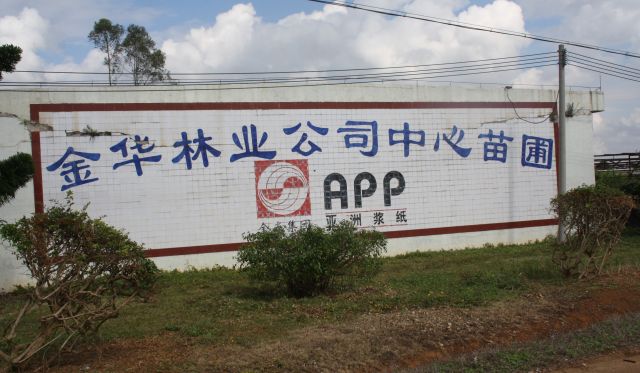
APP’s progress on implementing the far-reaching Forest Conservation Policy announced two years ago has received a cautious welcome by an equally unprecedented audit of one the ground impacts. The Rainforest Alliance says APP has made ‘moderate progress’ in the first 18 months.