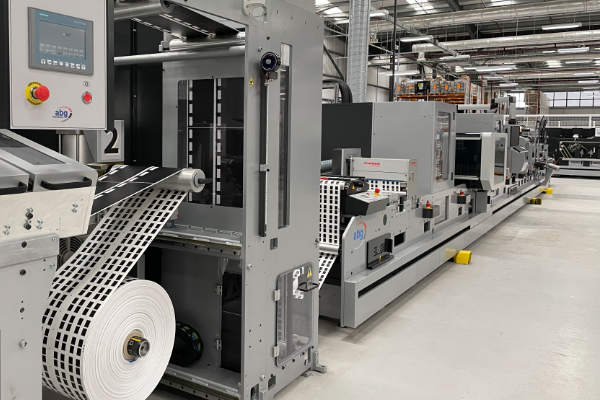
International Security Printers (ISP) has inaugurated a hybrid print line for the production of barcoded postage stamps. This will, for the first time, allow individual stamps and the items they are attached to, to be track and traced through the postal system, and will prevent fraud from secondary use of any unfranked or cleaned stamps.
The Wolverhampton business, part of a larger French business, is not naming the customer that this has been developed for, though it is known that a number of postal authorities are interested in and are investigating the use of barcodes to identify individual stamps. The same technology could find applications in tax stamps and other areas where there is a need to identify and validate a package or product.
ISP was previously Walsall Security Printers, with a long history in innovative stamp production, having begun by printing side cut and shaped stamps for Tonga in the 1960s followed by other Commonwealth countries. It was also involved in production of the Olympic Gold stamps in 2012, printing stamps to commemorate Great Britain’s winning athletes in that year’s Olympic games.
This project began as a concept in 2019, leading to specifications and ordering equipment from Domino, Lake Image Systems (acquired by Domino 12 months ago) and AB Graphic International last year. The set up is now able to print stamps in full colour using inkjet and to print an individual barcode alongside a definitive stamp. The equipment sits inside the existing facilities.
There are two configurations: one for flat sheet books of stamps, the other for roll printed stamps. Sheets of stamps are printed on the reel and loaded to ABG’s non stop unwind unit which includes an on the fly splicing capability. The web heads to ABG’s Omega converter 430, which includes a Domino N617i four-colour UV inkjet array. This prints the stamps together with the barcode in full colour. The web is slit and cut to deliver final sheets with Lake Image inspection systems to identify and reject any sub standard sheets. The sheets pass as a shingle to a 2m long conveyor.
The second system produces booklets of stamps and begins in the same way. In an extra step the smaller sheets of stamps are collated into a booklet with a Domino K600i printer used to print an identifying barcode on the outside of the booklet.
The project is ready to roll ahead of a November deadline for the introduction of the new style of stamps. Matt Burton, global sales director of ABG says: “This is the first time that various key industry parties have joined together to provide hybrid print and finishing solutions, for postal stamp applications. All manufacturers have been fully on board throughout the project, wanting to see a successful conclusion. Clearly, we are all delighted that both systems are now fit for purpose and we look forward to seeing ISP rolling out the initiative.”
ISP managing director Ian Brigham adds: “We are proud to be part of a monumental change in the history and fortunes of the postage stamp. The coming together of experienced print and finishing specialists to create these systems has been both unique and impressive.”
The concept of barcoded postal stamps was trialled earlier this year by Royal Mail. It applied the barcodes alongside a conventional stamp in the same colour and with a printed perforation line. Some 20 million were produced and sold through office supplies company Viking Direct and other online channels.
At the time, Nick Landon, chief commercial officer of Royal Mail, said: “This initiative will see Royal Mail become one of the first postal authorities in the world to add unique barcodes to stamps. By doing this, we are looking to transform the humble stamp so that we can offer our customers even more convenient, new services in the future. The pilot of barcoded stamps reflects our commitment to constantly evolve our products and services in line with the ever changing needs of our customers.”