
The technology is the same, the equipment is pretty much the same, and as volumes in commercial printing continue to shrink, more and more printers are going to be tempted by the idea of carton printing.
Packaging is not going to be replaced by the internet. Rather there indications that the internet is boosting demand for packaging, that packaging is taking on more of the burden of product marketing than ever before. Purchasing decisions are made at the shelf, favouring eye catching finishes to a carton; consumers are craving freshness and novelty, favouring frequent refreshes of design and new product launches.
This means that the long runs that many carton printers have been used to are melting away. The days of keeping a job on press for several days have gone. Instead there can be multiple make readies in a day, fast turnarounds and which commercial printers have been used to. What is happening in carton is following the same pattern as commercial printing.
Commercial printers know how to cope with these pressures. They are used to dealing with the small order values that larger groups have tended to shy away from. The presses they are using can cope with boards, prepress is all digital and if additional investment is needed to cut and crease and produce the carton blanks that are needed, this can be worthwhile. In the meantime there are trade finishers able to work with printed sheets.
Moving into carton printing is entirely logical. Seminars are being held to that effect in the US; press manufacturers are fielding an increasing volumes of inquiries about handling board through the press. The question is perhaps not Why? but Why not?
However, it may not be that simple. Last year there were suggestions of running a conference in the UK about this opportunity, but following feedback BPIF Cartons decided not to offer the proposed event. The market is in some kind of balance after many years of losing work overseas. There has been steady investment in equipment and a steep improvement in competitiveness. It is understandable that the UK’s carton suppliers do not want an influx of competition to disrupt the market in the way that commercial print knows best: through competitive pricing.
There have been examples of companies crossing the divide in the UK. The best known of these is Sherwood, which having been a greetings card printer started with an advantage as greetings card printer understanding board and its finishing requirements. It needed to acquire a failed carton printing business in order to achieve the breakthrough.
Others have been able to produce cartons within a limited scope and Bayliss has installed a new Rapida 105 with plans to offer trade carton printing as well as printing book jackets and other trade work. It would mean switching between conventional printing and UV printing, but the company is confident it can do this.
However it is going to be a tall ask as those suppliers already in the industry understand only too well.
Bobst is the leading force in carton finishing through a range of cutting and creating platens, foiling equipment and folder/gluers. UK managing director Craig Moran says that Bobst can help printers make the transition, but warns that there are plenty of hidden traps.
He says: “Possibly the most shocking aspect they will encounter is the ‘zero fault’ contract. Many packaging buyers want their cartons delivered straight to the filling line, almost to the minute they are needed. With no time for the packer-filler’s staff to check the delivery in detail, it has to be guaranteed to be ‘zero fault’.
“A single carton that does not erect correctly and causes the packing line to stop may result in the whole job being lifted, that batch of packaging being rejected, and a claim for consequential losses being raised against the packaging supplier for the lost production.”
Contracts can extend over several pages with specifications covering not just physical behaviour, but also colour consistency. It is no accident that the majority of companies working to ISO 12647-2 certified standards are carton printers.
Once printed, says Moran, the print business will need to hold stock for the customer to call off at very short notice. The risk that the design changes before the carton is delivered is often borne by the printer, who then has to calculate how much stock (and money) is going to be needed.
In the finishing area where Bobst is expert, there are further problems to watch out for. “Regardless of whether they finish their work in-house or send it out to a carton finisher, printers need to be aware of things like pack design. They might not fully understand the finishing implications of design decisions made by them or their customers. These can make a job very difficult to finish and can eat up any profit in it. For example, something as simple as failing to make varnish cut outs, for areas of a carton that will be glued, makes a huge difference to the ability of a folder-gluer to create the finished box,” Moran explains.
“Another example is flatbed die cutting. Converted cylinders simply don’t cut it when it comes to carton making. Flatbed die cutters have the speed, control and registration needed. And when it comes to die cutter tooling, it is easy for new entrants to the process to buy on price. But running with poorly made tooling normally means longer makereadies, lower speeds and lesser quality. Tooling design and manufacture is a vast topic that needs a lot of experience to master.
“At Bobst we produce a manual containing the essential data for making converting tools, preparing and executing job changeovers and putting Bobst die-cutters into production. This is the so called ‘ABC’ of die cutting and it has been adopted as the industry standard for the production of tools for die cutting equipment and for the efficient running of a die cutting operation.”
Not surprisingly Moran stresses the importance of how to move into carton printing, and the need for training, at all levels of the business, from the equipment operators to prepress, managers and sales people.
Roger Cartwright, who heads Friedheim International‘s converting portfolio, tells a similar story. Many commercial printers, he says, are investigating the suitability of ‘halfway house’ equipment like Kama‘s ProFold/a>, which can produce the different types of carton required, but which can also handle high capacity folders for the commercial side of a business.
“They an see it as a first step into carton printing – keeping their fingers on the edge of the commercial print world,” he says.
“You have to know what you are getting into,” says David Ward, managing director of Hubergroup UK, agreeing with Craig Moran’s observations. “You can’t finish cartons on a Cylinder.”
The consumables used in packaging are vital with the inks and boards at the forefront of this. The first need is to be able to print with UV inks. It is possible to print cartons using standard inks, but it means a limited market opportunity, Huber’s sales director Paul English points out. “There needs to be investment in knowledge and training for any printer planning to come into the packaging sector,” he adds.
A prime requirement is understanding what the regulations are. Major customers will specify the boards that are to be used, usually a choice of three suppliers to allow some wiggle room in negotiating a price. Inks likewise must conform to standards, which is absolutely essential for those contemplating producing food packaging.
“There is a whole range of challenges to consider,” says Ward. “The non food market is a little more accessible, but you must still remember that print is just one aspect of the job: you need to cut and crease, to window patch and structural design is an important part of the process. You need to understand how the box will be used, how it will be transported and how it will be used on the shelf. There is a whole raft of things to consider.”
Among these is the British Retail Consortium standards. These set the rules for how cartons used for food need to be produced. It demands absolute cleanliness in the factory, with hairnets for staff. A stray hair that finds its way onto the boards, into the carton and then remains inside the pack until the consumer opens his or her purchase can wreak havoc.
Likewise any contamination of a product by smell or cancer causing chemical compound can destroy the business. This means that inks, founts and solvents need to be managed carefully. Ink producers have a range of low migration inks which are guaranteed to hit the target set by the regulators. Huber’s low migration inks are its MGA range. “It’s essential to know what you are doing to make the right choice of materials for the application,” says Ward. “And that can be a minefield. This is print, but it’s a totally different set of rules.”
It has not prevented a number of commercial printers coming to Huber for help in making the transition to either full time or part time packaging production. “A few printers have done this successfully,” says Ward. “Though many have done so only after making an acquisition because they know they need the people, the skills and the processes. You have to be sure you know what you are getting into.”
Flint Ink’s Richard Wilson points out that ink makers have removed a vast number of compounds from inks used for packaging over the years, often ahead of legislation and scientific study into the effects of certain compounds. It is a safety first approach that has ensured that inks, especially UV inks, are safe to use for food packaging.
Flint’s experience in narrow web labels draws on the same pool of expertise as sheetfed litho. Sun Chemical likewise has the low migration inks that are crucial for any commercial printer to understand when contemplating packaging.
For those thinking of running both conventional work and carton work on the same presses, English points out that cleaning the press to be clean enough to print using low migration inks will take around eight hours. Every trace of ink has to be removed. “It can be better to go down the low migration route and to stick to it,” says English, “perhaps splitting the pressroom to do it properly.” A physical barrier will be needed between the two sections.
Even so printers are still looking at the opportunities, perhaps finding that stretched finances will not allow the investment needed. Says English: “It is better if you can pick and choose the customers that you start to work with to concentrate on the easier types of pack, but that is a more cut throat market and smaller carton printers will have that market sewn up.”
Huber is talking with customers about how to enter the carton market, so it is not impossible. “You should talk to your suppliers,” says Ward.
Each of the main press suppliers can supply machines for carton printing. The UK market has carton companies working with Komori, KBA, Heidelberg UK and it remains a stronghold for Manroland Sheetfed. The last press sold before that manufacturer’s financial crash was to Qualvis Print and Packaging.
But the press manufacturers are not supplying hybrid machines, nor presses that switch between the disciplines. For specialist carton printers, multi-unit presses can mean 12 or 14 units to cope with different coatings, inline foiling, varnishes and reverse side printing.
Heidelberg UK and KBA have been vying as supplier of the most complete press in this area, KBA taking a press for cigarette carton printing, followed by Heidelberg UK winning the order for a press to print confectionery packaging.
That the press manufacturers do not consider that the markets do not mix easily is graphically demonstrated at Heidelberg’s factory where there is a print media center for packaging in one part of the complex and a commercial print demonstration print media center in another building.
For KBA sheetfed sales director Chris Scully “it’s not about the machine, it’s about the process. Getting ink on a substrate is fine, but this is about so much more than that. We are talking to customers who are keen to explore the opportunities in carton printing, but it is not as easy as it sounds.”
KBA had an advantage in being able to offer large format presses. These were preferred by carton printers because the larger sheet provided more options for nesting different carton shapes within the print area and given the lengthy makeready times, this allowed greater productivity.
Now however, faster makeready and shorter print runs favours either B1 or even B2 printing. The pharmaceutical sector, which is just as fanatical as food packaging, has adopted B2 formats for the tablet boxes, though larger sheet sizes for the information leaflets that are needed in every box.
Heidelberg UK started in carton printing with the half sheet format with the introduction of the Speedmaster CD74, where CD originally stood for Carton Diameter to indicate that the double circumference cylinders could cope with the less flexible materials needed. It has learned a lot since then and now supplies across the formats with XL145 machines just as popular as XL75 Anicolor presses.
Scully stands back to survey the market, the preponderance of groups able to dedicate different plants to specific types of packaging and able to serve major clients on a worldwide scale and equally able to innovate. GPI, which bought Benson Group, for example, developed a microwaveable cardboard material which was then offered to food clients to develop foods which might take advantage of the substrate, or to switch from an existing, possibly plastic based container to a more eco friendly board.
“It means that the commercial printer is not going to get into food packaging,” Scully warns. Those best placed are those that are perhaps used to printing on boards for greetings cards or point of sale. Others will be printing cardboard packaging for customers that have approached them, planting a seed which might be developed. With these experiences the step across the divide is then more straightforward.
Scully too points out the huge risks from consequential loss, the need to develop a culture that is focused on carton production. It is definitely about treading carefully. It is not an impossible journey, but if anyone contemplating it should seek advice, get all the information possible and move forwards very cautiously.
Priory Press, a successful Northern Ireland carton printer, started printing on boards when one customer switched from on pack labels to sleeves for its ready mashed potato products. That was a decade ago after 30 years as a commercial printer.
Today Priory has expanded to cover all types of artisanal food production, helping new companies and brands with what might be the first piece of packaging that they have needed. It is completing a move to a new factory which will include a photo studio and kitchen so that it can create and capture the clients’ products looking at their best.
The first sample and testing runs might be produced digitally – for up to 1,000 units – but subsequent runs will be printed on its five- or six-colour litho presses.
The company is now almost entirely a packaging company, with sister company White Lace Wedding Stationery sharing premises and facilities like its foil blocking machinery.
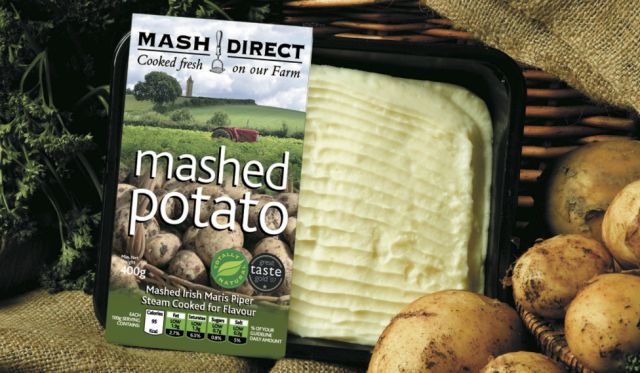
Priory Press Packaging, a successful Northern Ireland carton printer, started printing on boards when one customer switched from on pack labels to sleeves for its ready mashed potato products. That was a decade ago after 30 years as a commercial printer. Today Priory has expanded to cover all types of artisanal food production, helping new companies and brands with what might be the first piece of packaging that they have needed. It is completing a move to a new factory which will include a photo studio and kitchen so that it can create and capture the clients’ products looking at their best.