
KBA is braced for a year where there is no overall growth in press sales, but reckons that its programme of reshaping the business puts it in a good position to achieve sales above €1 billion and a margin of 2% on sales.
While the overall market is expected to be static, there will be growth in digital at the expense once again of webfed business. In response KBA has created a new Web & Digital division, anticipating permanently lower volumes in web press sales. And while sheetfed sales in 2014 increased by 3.3% over 2013 sales, KBA anticipates that a pre Drupa slowdown will affect this trend.
The sheetfed operations are now organised as KBA Sheetfed Solutions, a standalone unit along with the new KBA Web & Digital Solutions and with KBA Industrial Solutions. These will have greater autonomy than in the past and will be better placed to respond to market changes. The holding company will provide the shared admin, treasury and similar services. The new structure came into place at the start of the year and will be ratified by shareholders at the AGM in May.
The new organisation is intended to make KBA a more flexible entity. It has required the loss of 1,500 jobs to leave the German press manufacturer with 4,500 permanent posts by the end of 2016, but has also included investment in new machining and plasma coating operations. As a result, the company’s Czech plant, which produces B2 sheetfed presses reported an operating profit in 2014.
The new KBA is less dependent on advertising-led print markets and is tilted more to packaging. A decade ago, presses for newspapers, books and magazines accounted for 60% of turnover. That is down to less than 15% says CEO and president Claus Bolza-Schünemann. Growing demand for carton presses means that 80% of sheetfed sales are now to the packaging sector, while with the acquisitions of Flexotecnica and Kammann , KBA has increased its presence in speciality packaging with flexo and direct to bottle printing. A joint venture with HP to develop an inkjet press for corrugated liner printing continues this trend.
The company shipped its first Rotajet VL168 inkjet press during the year to a wall decoration printer. The target for these presses is about applications with challenging materials and large substrate widths, not the commercial print sector in other words.
The Web & Digital division is “now a significantly smaller business division [shaped] to soon return to appropriate profitability”. Incoming orders for the web division fell by 14.2% to €346.8 million (€401.2 million) and the backlog of business at the end of 2014 in the web and special press area combined dropped by close to half to €188.5 million (€351.2 million). “We have limited ourselves to projects with acceptable margins,” its annual report states.
In contrast end of year backlog on sheetfed rose 9.3% to €228.8 million (€209.3 million) with incoming orders in the year rising to €610 million (€608 million) helping to secure an operating profit of €11.5 million for the year. This is set against background conditions of further market tightening where according to German engineering federation, the VDMA, press sales in 2014 were 5% down on the previous year.
Certainly business in Asia, led by China, reflects this, falling o 23.9% (27.4%) of the overall and in the US where growing demand for sheetfed presses could not compensate for the continued depressed state of web press sales.
The combined effect was that KBA ended 2014 with sales of €1.1 billion, on a par with 2013, generating €14.1 million of operating profit and €5.5 million of pretax profit, compared to a loss of €130.7 million at the operating level and €138.1 million at the pretax level in 2013. Bolza-Schünemann points out: “We made rapid progress in the first 12 months of the most extensive realignment project in our company’s recent history and were pleased to see its positive effects earlier than anticipated.”
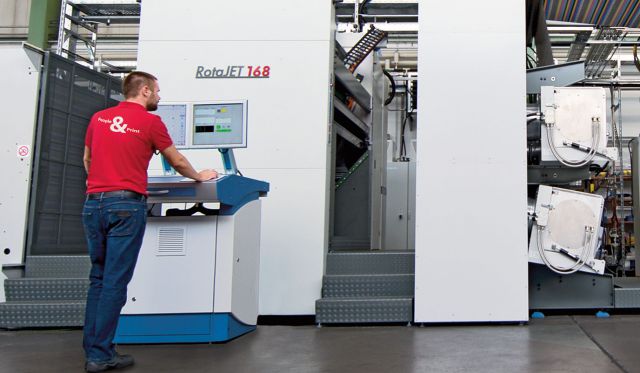
KBA has placed its web offset and its digital press businesses together in the same division. It has sold the first of its Rotajet VL presses and is collaborating with HP on a press suited to printing corrugated top liners.