
More than 30 years of development has taken inkjet from research labs in the UK, US and Japan to the threshold of becoming the dominant print technology of the 21st century.
And that development will continue, spawning an ecology of print head species, machine genres, inks and applications that point the way for higher quality, more predictable printing on a greater range of materials than has ever been possible before. It is not the perfect print technology, at least not yet: inks remain expensive, production speeds can be low and printing at speed on paper remains troublesome.
But if insurmountable now, these problems will fade both as technology reduces the importance of cost and as market trends erode the importance of price.
Not surprisingly inkjet is attracting huge amounts of investment from those that have been at the forefront of the technology like HP and Canon and from those seemingly wedded to litho printing, like Fujifilm, Agfa, Kodak, KBA and Heidelberg. It is the technology underpinning Landa nanography and the desktop printer with a Memjet print array. Inkjet can be both highly complex and seemingly simple. And because inkjet heads can be arranged on all kinds of devices, inkjet opens the way to print wood laminates, textiles, wallpapers, labels directly on to bottles and footballs, electronic circuitry and sensors.
At heart all inkjet is is squirting a liquid carrying a colouring through a small orifice. This is how palaeolithic man produced cave art, blowing ground up pigment mixed with a fluid through a straw at the rock wall. Today the orifice is much, much smaller and the methods of blowing much much more advanced. In effect there are three major ways of moving the ink through the hole.
The continuous inkjet principle where ink is continually pumped through the nozzle and deflected in some way to create the image. This was the first to make an impact on the graphic arts through the likes of Videojet, Domino and Mead which became Kodak, was sold to Scitex and is now Kodak again. Kodak’s Stream technology used in its Prosper heads is the acme of this system. The advantage is its speed and small droplet size which is able to deliver increasing levels of quality. It is currently the fastest inkjet technology available to printers.
The second technology is thermal inkjet, developed in parallel by Canon and HP, though only the latter has used this in production print machines, namely its T series web presses. A heating element boils a tiny amount of ink creating a bubble of steam which expands to force ink through the nozzle to the paper. The ink has to be water based and the constant explosive nature of the process means heads are considered expendable. In practice this has not been the issue once thought it might become for HP customers.
The third fundamental technology for firing droplets is mechanical, the ink being expelled by a pumping action, caused by the flexing of a piezo crystal in response to an electric current. The constituent of the ink is less important, so more viscous inks and resins can be fired by this drop on demand technology as well as aqueous substances. In general aqueous inks are used for speed, web presses from Océ, Screen, Xerox-Impika and Ricoh for example, while thicker UV curable inks are used for non absorbent surfaces across the multitude of flatbed inkjet presses on the market. UV inks will also be used in narrow web presses for label printing, while solvent carriers can also be fired, again for display printing.
The sheer variety and availability of third party print heads makes piezo the most adopted and flexible of the inkjet technologies. As well as firing a wide range of materials, the heads are robust and provided they are kept clean (no nozzle will take kindly to being left with tiny droplets of UV ink to dry through stray light for example) will rarely if ever need changing. Nozzles can become blocked by the viscous nature of the fluids, leading to through flow head designs. There is plenty of scope to increase the speed of piezo printing.
Piezo heads are produced by a number of developers. Kyocera is one of the fastest heads available, Xaar produces heads which in use for so called industrial applications, ceramic tiles for example, as well as labels, Fujifilm Dimatix supplies its own parent company as well as heads for non graphic arts applications, Epson is crafting a family of products around its PrecisionCore technology, Ricoh has been building heads for 30 years, for desktop use for the most part. And the list goes on.
The other crucial aspect is the ink. The job of the inkjet press developer is to combine the profile of the print head with an ink to produce the desired characteristics. This covers speed, droplet sizes, spread and drying behaviour and will involve microscopic examination of the electrical wave formations used to fire the ink and the formation of the droplets as a result. Because a head can fire tens of thousands of times a second and droplet sizes can run from 2pl to 27pl and more, this requires some seriously specialised equipment and engineers. Matching the head and the ink is a specialised business. Little wonder that ink can be the most expensive fluid in the world.
However, it delivers one of the key attractions of inkjet printing. The customer is almost locked in to his technology provider and while the price of ink will fall it will not be commoditised to the extent that litho ink has become, where printers can hop from one supplier to another with little concern that a new ink will damage his press.
Quality is a reflection of resolution but not necessarily only this. Specifications will quote a number of dots per inch, 200dpi in the first barely legible systems for real printing up to 1200dpi now. This explains the number of nozzles cut into a printhead, almost always in two rows slightly staggered from each other so that the arrangement of nozzles drilled into a plates is 600 in an inch. The dimensions of the nozzle and the firing rate determine the droplet size. Most piezo heads will produce a range of droplet sizes, the smallest for the finest details, the largest for the most rapid coverage. Wide format print is comfortable with larger droplets as quality is generally viewed at a distance, graphic arts quality demands smaller sizes, starting at 2-3pl. It will become essential to print a test chart including grid patterns to assess one machine compared to another, but currently no such standard approach exists.
Each head is itself relatively small, decided by the engineering task of positioning the nozzles accurately in line with each other. The failure rate MEMS production techniques, used in electronic circuitry and based around sandwiching layers of material rather than mechanically drilling nozzle holes, offers a way to overcome this limitation and has been used by Memjet and HP to build so called page wide heads. They offer a more cost effective way to print, but a small number of nozzle failures will mean the whole array needs replacing rather than a section of it.
Positioning smaller heads in a line calls for engineering solutions to ensure that the nozzles line up with each other across the full print width, which has been a limitation. Nobody is yet advocating B1 wide printing presses using single pass systems. On wide format machines, heads are mounted on a carriage which prints as its slides back and forth across the flatbed or reel, but for single pass printing, the head has only one chance to print.
The Fujifilm Samba head for example is trapezoid in shape which allows heads to be locked together tightly and accurately so should overcome issues of alignment. Others have different means of solving the same issue.
The final question for inkjet printing to overcome is that of driving these heads. On the B2 Jetpress 720 there are 34,816 nozzles per print bar, firing at up to 100kHz. That is a vast amount of data to shift multiple times per second. It is possible in computing terms, possible even for the Landa press running at 10,000 sheets an hour for a B1 machine. EFI is building the front end for that. It has not disclosed the architecture involved, whether Ripping to store or Ripping on the fly or some combination or both.
It is a long way from the sophisticated mangle approach that some use to describe litho printing, but none of it is impossible. Inkjet is coming.
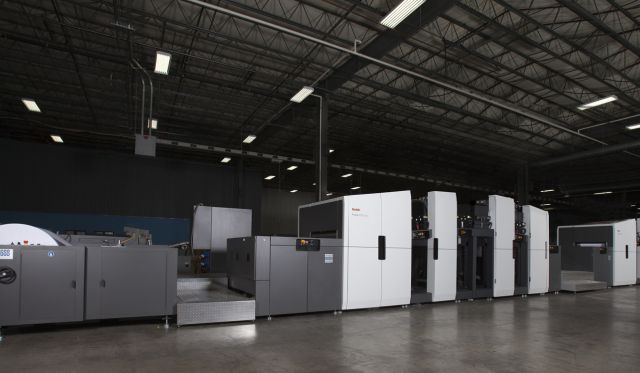
Kodak is the granddaddy of inkjet in the industry thanks to its Versamark continuous inkjet technology. It then offered a third party piezo inkjet system before developing the Stream technology used in its Prosper presses and heads. This year it announced the Prosper 6000C and 6000P aimed at commercial printing and publishing applications, while its Prosper heads have been attached to sheetfed presses (Anton Group) to newspaper presses (Newsprinters and Bild) and will be used in a corrugated carton press (Bobst).