MacroArt had a tough year in 2020. It had to reduce the size of the workforce and is now leaner and has plans to be an awful lot greener. And this is not only about moving away from PVC, but looking at the entire process, energy consumption, transport as well as the choice of substrates and what happens to these.
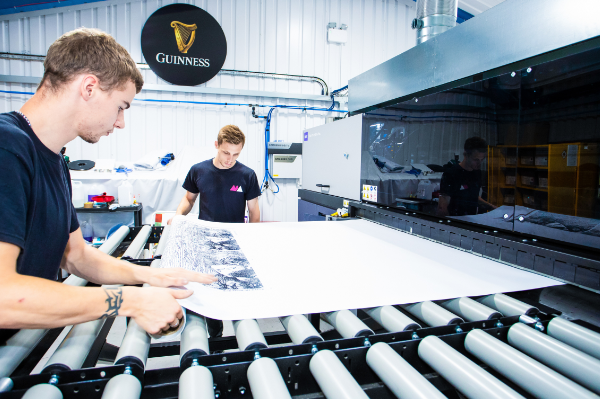
The company occupies a large site in St Neots, close to the A1 to give ready access to the road transport network. This has served it well from early days on out of home through expansion post 2000 into retail, exhibitions and events. It has continued to invest in technology, one of the first to move into dye sublimation and production of aluminium frames for tension materials.
Now it aims to be at the forefront of the next wave, where customers demand information about how and where their products are made and what the environmental impact will be.
That has led to a search for a viable alternative to PVC. “We need something to have the strength of PVC for building wraps,” says managing director Michael Green. “At one time there was a PVC material which claimed to be biodegradeable, but those claims never stood up and any alternatives have always been very, very expensive. Now however, pressure to be environmental means that material manufacturers have started to provide PVC alternatives.”
The best of these to date is Kavalan and has been put through its paces at MacroArt. “It has the strength of PVC, but is much lighter than PVC. We are happy with the print quality. And it has strong environmental credentials so a lot of people are talking about using it. We are glad that it’s around.”
However, this alone will not satisfy MacroArt’s determination to become greener. Scratch the surface and a lot more is revealed says Green. “We feel we need to take a much more holistic approach.
“When we pitch for work people across the board, even in the construction industry, are asking questions about sustainability, our procedures, what materials we are using. Sustainability is becoming more and more important.”
As well as a major user of Kavalan, MacroArt has developed a closed loop system to recycle PET and ACM into new rigid panels. “There is still room for improvement,” he says.
Enter David Humphreys. He has joined the business in 2019 to guide it on this journey, starting with an audit to set a baseline. That was a huge carbon footprint of 2kg/m2 of material produced. “Our policy is to reduce that amount year on year,” Green says. “It means looking at every single aspect of our business – the power we use, our recycling streams, the fuel used in delivery vans.”
The biggest impact says Humphreys is from the materials that are used, and are largely beyond the control of MacroArt. Unlike commercial print where printers are using an inherently sustainable resource in paper, display materials are in the main a form of plastic, PVC being the worst because of its with end of life problems. “If all the materials could be CO2 neutral, the company would only have to worry about is energy consumption and cars. Substrates are the fundamental contributor to the company’s CO2 output.
PVC is nasty, but Kavalan is still made from some of the same materials. It is still using a polyester base yarn that is coated, though with a different material to PVC and one that can split from the yarn easily. It’s a big step in the right direction.”
What cannot be recycled can be directed to incineration to capture the energy element of the material. PVC cannot be burned and routes for recycling or reuse have been closed off through the pandemic. “Recycling is not the be all and end all, because it can consume vast amounts of energy. Though it is better than having piles of rubbish all around,” says Humphreys.
The Vutek and Durst printers that MacroArt uses have switched from MV lamps for UV curing to LED, resulting in big drop in energy consumption. Inks are far more environmentally friendly than those used in the early days of the business. Now it has implemented a new ERP system to go completely paper free across the business.
The five-year journey began in 2019, with the first roadmap towards becoming a sustainable business. It is researching energy providers, looking at fuel efficient transport and moving into Scope 3 areas of the consumables it uses. And says Green, it is communicating both downstream and upstream, “making clients aware that MacroArt is doing this. We want to engage with them in grown up discussions, offering alternatives that might be 5% more expensive, but that the footprint is down 50%”.